Nursing Diploma Recognition in Switzerland: The SRC Process

The short answer
In Switzerland, foreign nursing diplomas are recognised by the Swiss Red Cross (SRC). You first fill in the free PreCheck, then submit your application, and you get a first decision no more than four months after your file is complete. Including the register entry, that costs CHF 680 for EU diplomas listed in Annex V, otherwise CHF 1,060 or 1,130.
That's what the SRC's own page says. What it leaves out is how the procedure works in practice: why a German diploma can still end up on the long route, how long it really takes to get a complete file, and when the canton wants a licence of its own on top. To find out, we read the federal ordinances alongside the SRC's pages, and four rulings of the Federal Administrative Court from 2021 to 2025. In all four, an applicant appealed against an SRC decision, and the case files show where things get stuck. Most of the legal texts and all the rulings are only available in German, French or Italian; we link the German versions.
Who recognises your nursing diploma?
The SRC does, on behalf of the federal government. That's set out in the federal ordinance on recognition in the health professions, known by its German abbreviation GesBAV. Nursing is a regulated profession in Switzerland: to work as a registered nurse, you need a Swiss diploma or a recognised foreign one. The SRC's FAQ states plainly that recognition is required by law.
Your qualification is compared with two Swiss programmes: the nursing diploma from a college of higher education (HF, Höhere Fachschule) and the Bachelor of Science in Nursing from a university of applied sciences (FH, Fachhochschule). Under the Health Professions Act, both are equally valid entry routes into the profession. If you're not sure whether your profession is regulated at all, search for it on recognition.swiss, the federal platform for foreign professional qualifications.
The SRC doesn't help you find a job, and it only offers personal advice if you book by phone first. You can have a person or a company represent you, but that won't speed things up. Which route applies to you mostly depends on one list in an EU directive.
EU procedure or standard procedure?
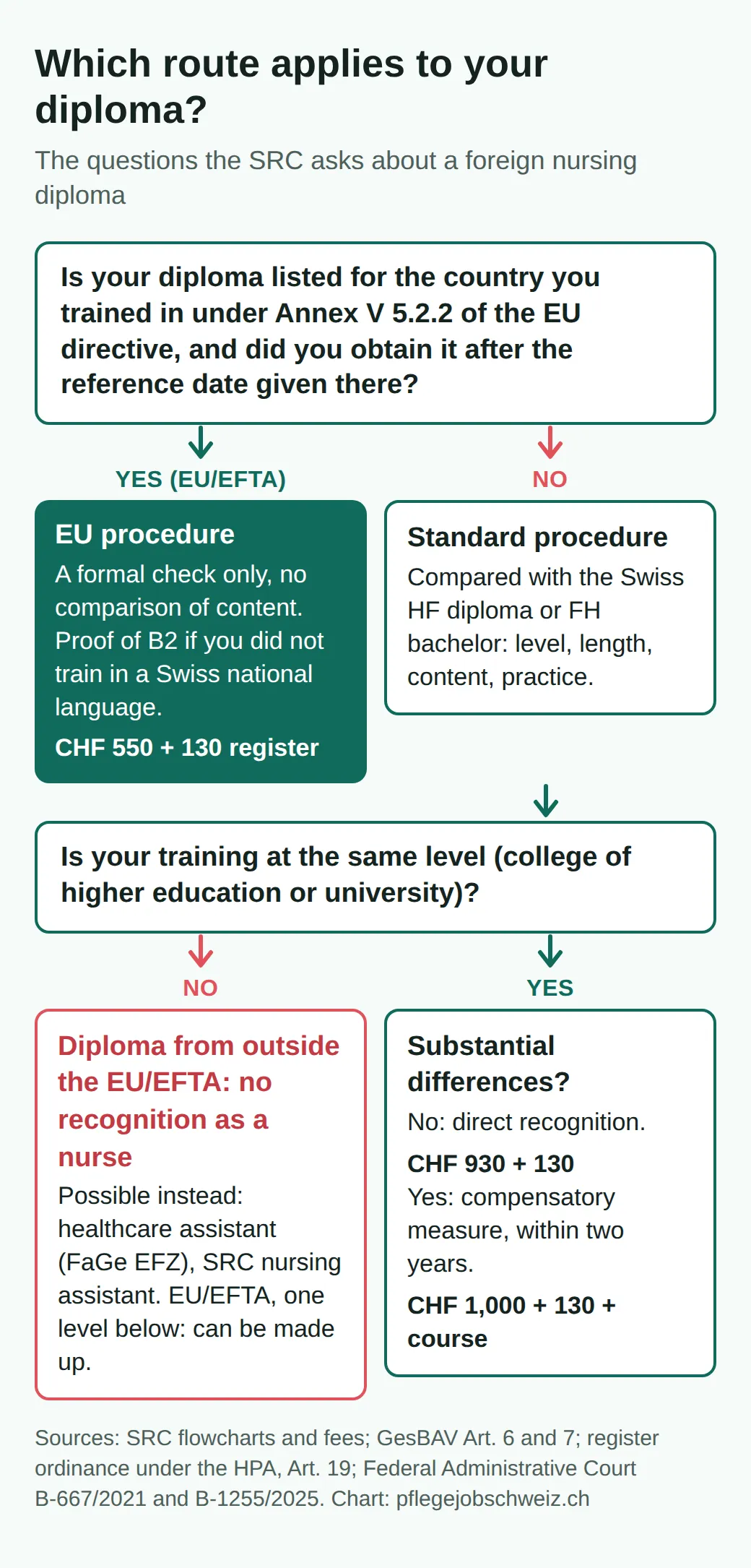
There are two routes, and the short one is only open to some diplomas. The EU procedure applies if your qualification appears in Annex V of Directive 2005/36/EC under the country where you trained, in section 5.2.2 for general care nursing, and you obtained it after the reference date given there. The SRC lists 31 countries for this: the EU member states, Iceland, Liechtenstein, Norway and, under a transitional rule, the United Kingdom.
In that case the SRC only runs a formal check: whether your documents are complete, whether your qualification is listed in the annex and whether you need proof of language skills. There's no comparison with Swiss training and no classification as HF or FH. That's how the SRC's flowchart for the EU procedure shows it.
All other diplomas go through the standard procedure. Here the SRC compares four things with Swiss training: level, length, content and the practical parts, as Article 10 of the Health Professions Act requires.
An EU diploma can still take the long route
The annex is narrow. In its 2021 consolidated version, it lists for Germany the state examination certificate in nursing with the professional title Gesundheits- und Krankenpflegerin (general nurse). A German paediatric nurse (Gesundheits- und Kinderkrankenpflegerin) who trained in 2011 therefore ended up in the standard procedure. In March 2025 the SRC required a six-month adaptation course in adult or long-term care, or an aptitude test. The Federal Administrative Court overturned that partial decision in ruling B-2758/2025: the SRC hadn't waited for her school's curriculum and hadn't explained precisely which content was missing.
A second case shows a different trap. A Polish nurse had finished a medical secondary school in 1996 and received her licence as a nurse in Germany in 2023. For Poland, though, the annex only lists university degrees. And the German licence doesn't count as separate training in Switzerland, the court held in ruling B-1255/2025. So even if another country has recognised you, the SRC still looks at your original diploma. What the two routes cost, on the other hand, is set out precisely.
How much does SRC recognition cost?
The fee depends on the route and comes in one or two invoices. In the EU procedure you pay CHF 550 in a single invoice. In the standard procedure you first pay CHF 600 with your application. The second partial invoice is CHF 330 if you're recognised directly, or CHF 400 once you've passed the compensatory measure. On top of that, there's CHF 130 for the entry in the National Register of Healthcare Professions (NAREG). For nurses this entry is compulsory, and the fee is set in Article 19 of the register ordinance. That's the breakdown in the SRC's two flowcharts, the standard procedure and the EU procedure.
| Route | SRC invoices | Register | Total |
|---|---|---|---|
| EU procedure (Annex V) | CHF 550 | CHF 130 | CHF 680 |
| Standard, direct recognition | CHF 600 + 330 | CHF 130 | CHF 1,060 |
| Standard, with compensatory measure | CHF 600 + 400 | CHF 130 | CHF 1,130 plus course |
The SRC can't charge more than CHF 1,000 for the recognition itself. SERI's fee ordinance sets a range of CHF 90 to 1,000 for recognitions. If you withdraw your application, you get nothing back.
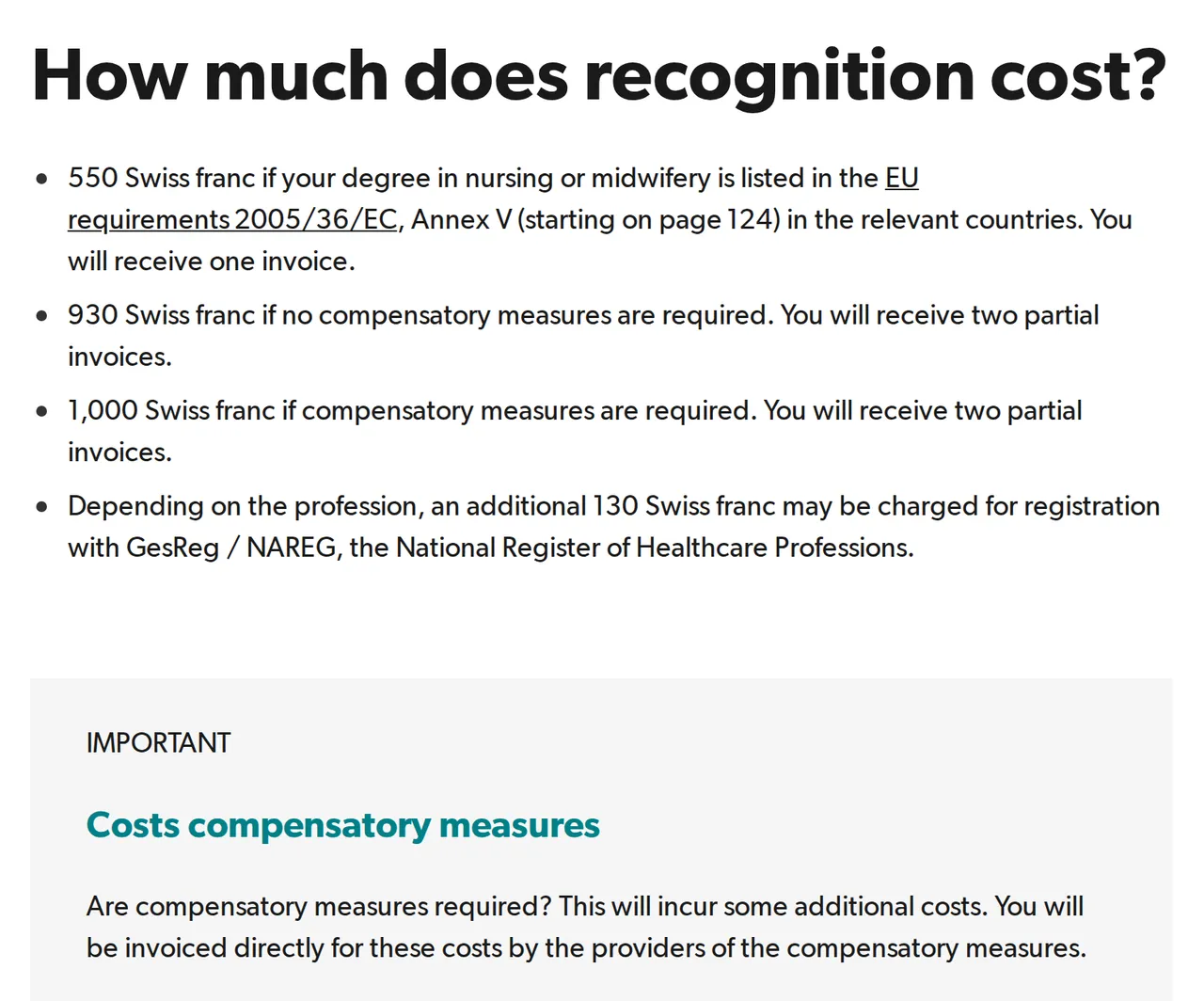
These figures don't include the cost of a compensatory measure. Providers bill that directly, and the SRC gives no amount for it. Certified copies, translations and certificates from abroad are also at your own expense. But money isn't the whole story: the bigger cost is often time.
How long does recognition take?
On paper, about five months to the first decision. According to the SRC, the PreCheck takes no more than four weeks, and the application after that no more than four months. But the clock only starts once the SRC has all your documents and the first invoice has been paid. If you then need a compensatory measure, you have two years to complete it.
The court files show how big the gap between applying and having a complete file can be. The German paediatric nurse applied on 30 June 2024, and her file was complete on 7 January 2025. For the Polish nurse, the review took longer than gathering the documents.
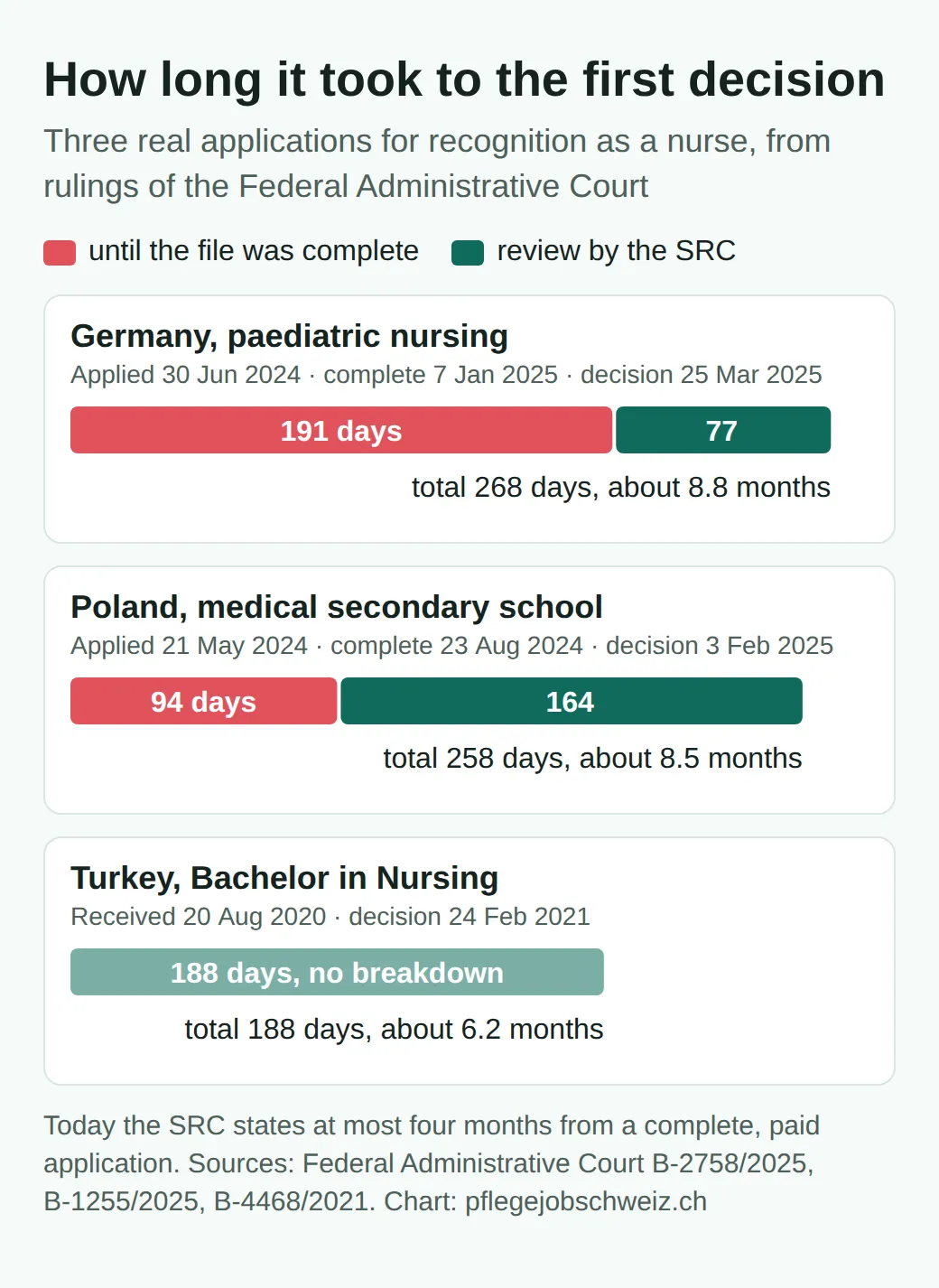
In all three cases, it took from just over six to almost nine months between the application and the first decision. The cases date from 2020 to 2025. Whether the SRC meets its four-month deadline today is something we can't check. Your documents are where you can save the most time.
The documents, above all the CCPS
You only get the full list with the application form. But one document takes time to get: the certificate stating that you may work in your profession without restrictions. Depending on the country, it's called a Certificate of Current Professional Status (CCPS) or a Letter of Good Standing. It comes from the authority in the country where you last worked, and it must be no more than three months old when you submit your application. You don't need it yet for the PreCheck.
According to the SRC, it must show your name, your profession, a statement on sanctions, the issuing country and authority, the date and a signature. A short request to the authority could read like this:
Subject: Request for a Certificate of Current Professional Status
Dear Sir or Madam, to have my nursing diploma recognised by the Swiss Red Cross, I need a certificate confirming that I may practise my profession without restrictions and that no sanctions have been imposed on me. Please state my name, my profession, the issuing authority and the date, and sign the document. Diploma dated [date], registration number [number]. Kind regards, [name, date of birth]
If your country has no register, or you've never worked there, the SRC asks for a Certificate of Non-Registration and a criminal record extract no more than three months old. If you've already worked in your profession in Switzerland for more than five years, you send employment references, a Swiss criminal record extract and a licence, examination or registration instead. For the EU procedure you also need the certificate of conformity, also called the EU certificate. It confirms that your qualification meets the directive, and it comes from the authority in the country where you trained.
The SRC generally doesn't want originals, but it does want officially certified copies, made for example by a notary or your municipality. It doesn't accept an apostille for this. Translations into German, French, Italian or English must come from a recognised translation service or a sworn translator. If your training falls short somewhere, the next stage follows after the review.
Adaptation course or aptitude test
If your training differs substantially from Swiss training, the SRC requires a compensatory measure. The SRC names three forms: an adaptation course, an adaptation course combined with an additional training course, or an aptitude test. The legal basis is Article 7 GesBAV, and you pay the costs.
On an adaptation course you work in your profession, possibly in your current job in Switzerland. Your employer provides a mentor who, according to the SRC, works on the same ward, is trained in nursing, is employed at least 60 percent and has been approved by the SRC. The mentor holds a progress review with you at least every three months and assesses you at the end using an evaluation form. You may only start once the SRC has ordered the course, received your choice and approved the mentor, and once any conditions set by the canton are met. The additional training course consists of theory lessons. The aptitude test consists of a written exam and a technical discussion.
Where the rulings give a length, the SRC required a six-month adaptation course: for the German paediatric nurse, and for a nurse with a bachelor's degree from Turkey. In her case, the SRC showed its working: Swiss HF training comprises 5,400 hours, half theory and half practice, and hers 3,304 hours. The court upheld the measure in ruling B-4468/2021. The Polish nurse pointed to 26 years of experience and still lost: experience can't make up for a difference in level, the court held, and work under supervision doesn't count as professional experience within the meaning of the EU directive.
The rulings also show your rights, at least for diplomas from the EU. It's up to the SRC to prove substantial differences, not you, and the choice between an adaptation course and an aptitude test is in principle yours. You can appeal against a decision to the Federal Administrative Court within 30 days (Article 50 of the Administrative Procedure Act). That means paying an advance on costs: in the German case CHF 1,500, which she got back after winning. In two cases lost in 2021 and 2025, the court costs came to CHF 1,000 each; in the third, the court had waived the applicant's costs. Things get harder when it isn't the content that doesn't match, but the level.
When your level falls short
Here it matters where you and your diploma come from. In Switzerland, nursing at upper secondary level is the healthcare assistant apprenticeship (Fachfrau or Fachmann Gesundheit EFZ), while registered nurses sit one level higher, trained at a college of higher education or a university of applied sciences. If your diploma is below that level, the Agreement on the Free Movement of Persons with the EU decides whether you can go any further.
For citizens of the EU or EFTA who trained there, the EU directive applies. It allows recognition even when a diploma sits directly below the required level, with a compensatory measure. That's what happened to the Polish nurse: her qualification was one level lower, and instead of a refusal the SRC required a compensatory course in nursing or an aptitude test.
For diplomas from outside the EU and EFTA, only the Swiss ordinance applies, and it's stricter. If the compensation would amount to a significant part of Swiss training, there's no compensatory measure (Art. 7 para. 2 GesBAV). Ruling B-667/2021 concerns a woman from Bosnia and Herzegovina with a four-year diploma as a nurse in gynaecology and obstetrics. In 2018 the SRC had recognised it as equivalent to a healthcare assistant (Fachfrau Gesundheit) after a six-month adaptation course. It turned down her later application for recognition as a registered nurse, because a difference in level can't be made up. The court agreed.
That's not the end of the road. The SRC can recognise your qualification as equivalent to a Swiss vocational qualification, for example healthcare assistant EFZ (Art. 6 para. 4 GesBAV). That doesn't get you into the National Register of Healthcare Professions. But a qualification at upper secondary level is the entry requirement in Switzerland for the three-year HF nursing programme, as the SRC put it in the ruling. For nursing assistants, the SRC also runs its own equivalence procedure (in German), with B1 instead of B2. Whatever your level, you'll rarely get anywhere without proof of language skills.
What language level does the SRC require?
B2 in German, French or Italian. The SRC lists the certificates it accepts: for German, the Goethe-Zertifikat B2, telc Deutsch B2, TestDaF at levels 3 to 5 and the ÖSD Zertifikat B2; for Italian, CELI 3; for French, among others, DELF B2 and TCF tout public B2. In a case-by-case review, the SRC will only consider your application once you know one of Switzerland's official languages as well as any compensatory measure would require (Art. 5 GesBAV). In the EU procedure you don't need proof if you trained in one of Switzerland's national languages.
The canton takes another look later on. For the licence, you need a good command of the official language of the canton where you work. So if you trained in Italy and want to work self-employed in Zurich, you'll need German at B2 despite your recognition. Before the licence comes up, though, there's usually another question.
Working while your application is pending
Whether you may work in a hospital or care home without recognition, and for how long, is up to the canton. The SRC says so on its page for employers, and refers employers to the cantonal health department or the cantonal medical service. There's no Switzerland-wide rule. So ask your future employer what applies in their canton before you hand in your notice or move.
If you're doing an adaptation course, the job itself is part of your recognition. For billing health insurers, SASIS AG can issue a provisional control number (K number) as soon as you sign up for the compensatory measure. After recognition, the SRC recommends that employers hire you on the same terms and at the same salary as people with a Swiss diploma.
If you're from a third country, meaning not from the EU or EFTA, there's an extra hurdle before you even apply. According to the SRC, you must have the right to live in Switzerland and a valid residence permit. Those permits are issued by the cantonal migration offices, not the SRC. Once you're recognised, there's one last office to deal with.
When you need a licence from the canton
Only if you work under your own professional responsibility, meaning not under the supervision of another registered nurse. That covers the self-employed, but according to the SRC also employees who don't report professionally to anyone, and it's set out in Article 11 of the Health Professions Act. If you work in a team under the professional supervision of a registered nurse, this rule doesn't require one. The licence requires recognition, trustworthiness, good health and the canton's official language.
Zurich: CHF 800
In the canton of Zurich, a first licence costs CHF 800 and a renewal CHF 200; it's valid for ten years. The cantonal health office (Amt für Gesundheit) usually processes a complete application within eight weeks at most, and German at B2 is compulsory. That's what the information sheet for nurses (in German) says. If you hold a licence in an EU or EFTA country and work there, you may work as a nurse in Zurich for up to 90 working days a year without a Zurich licence. You have to notify the federal government and the canton, and Zurich charges CHF 200 a year for this.
Basel-Stadt: CHF 400
In Basel-Stadt, the licence costs CHF 400, and the review usually takes eight weeks. On its page on nursing licences (in German), the canton's Medical Services (Medizinische Dienste) advise applying at least two months before you start. If you already hold a licence from another canton, you pay nothing. To bill basic health insurance, Basel-Stadt also requires two years of practical work under the direction of an authorised nurse.
What you can do this week
Start by looking up your diploma in Annex V of the directive. If it's listed under the country where you trained, with the right title and after the reference date, your route is short. If it isn't, plan for the standard procedure with a possible compensatory measure, and talk early to an employer who can provide a mentor.
Only order the CCPS or Letter of Good Standing once your PreCheck is positive, because it can be no more than three months old when you submit. In the meantime, get copies certified and translations done, and take the B2 exam if you need to. The more complete your file is when you first send it, the sooner the SRC's deadline starts running.
Common questions
- Can an agency handle my SRC recognition for me?
- Yes, with a power of attorney that you send in with your application. From then on, the SRC sends every decision, letter and email only to the person you've authorised. It won't make your application any faster: the SRC treats all applications the same way.
- Do I get the SRC fee back if I withdraw my application?
- No. The SRC refunds nothing if you withdraw. So only apply once all your documents are together and you really want to work in Switzerland.
- How long is SRC recognition valid?
- For your whole working life. The SRC can only revoke it if it was obtained unlawfully. If you lose your certificate, the SRC issues a duplicate for CHF 160.
- Can I call myself a nurse HF or FH after recognition?
- No. The HF and FH titles are only for people who trained in Switzerland. Recognition lets you use the Swiss professional title Pflegefachfrau or Pflegefachmann (registered nurse), together with your foreign title and the country it comes from.
- Do nursing assistants need their qualification recognised in Switzerland?
- Each canton decides that for itself, so ask the health department of the canton where you'll work. On request, the SRC checks whether your knowledge matches its own nursing assistant course (Pflegehelfende SRK). That costs CHF 250, or CHF 500 with a work placement, and requires German, French or Italian at B1.