Mandatory flu vaccine for nurses in Switzerland? 2026 rules

Before flu season
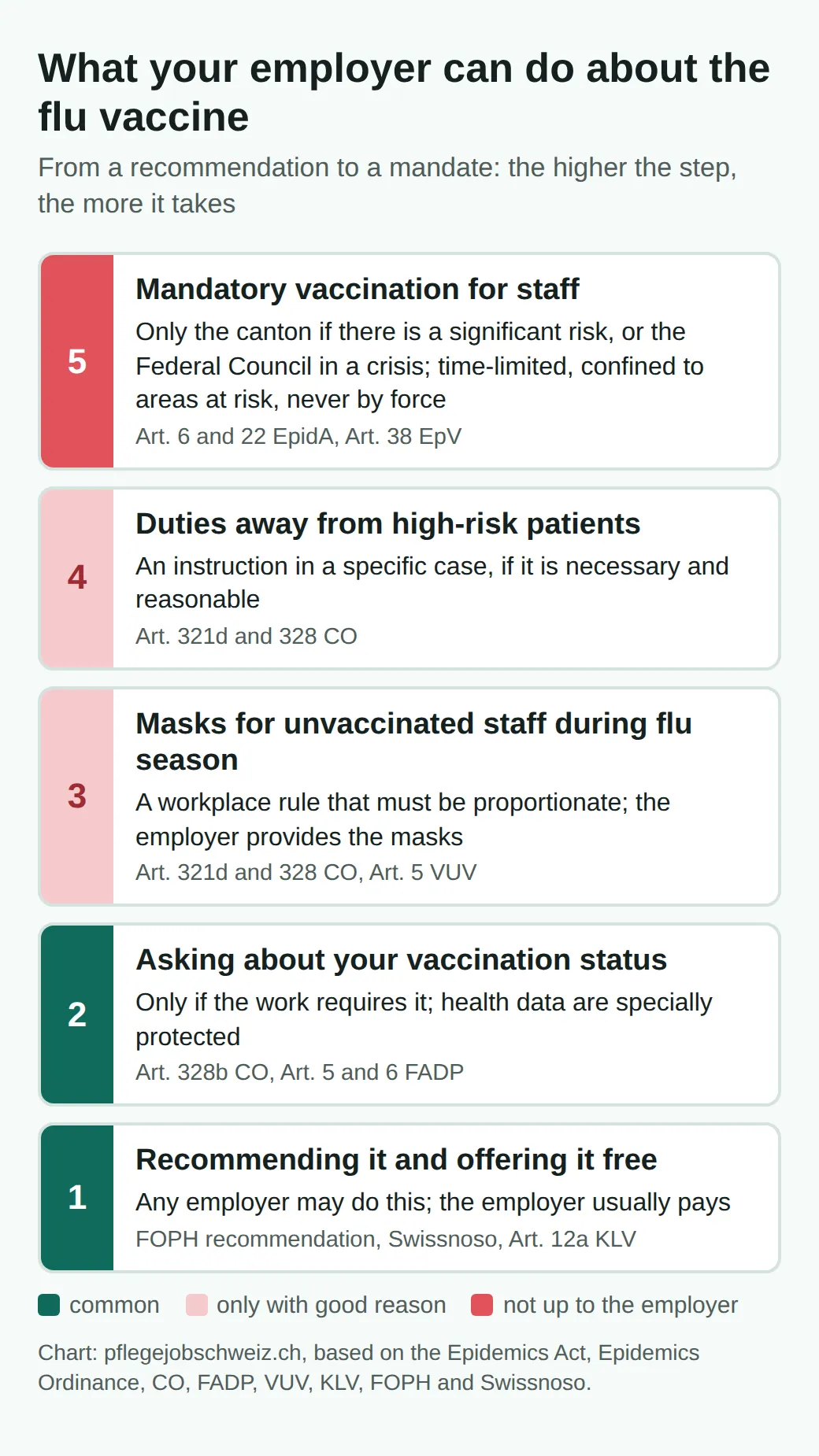
Nurses in Switzerland are not required to get a flu vaccine: the Federal Office of Public Health (FOPH) recommends it, and that's all. A real vaccination mandate could only come from the canton, or in a crisis from the Federal Council, for a limited time and never by force. Your hospital, care home or Spitex home care service may offer and pay for the vaccine, and in most cases may require unvaccinated staff to wear a mask during flu season. Your employer may only ask about your vaccination status if it needs to know for the work, and your answer is specially protected health data.
That's the short version. If you search for the topic in autumn, you'll mostly find newspaper articles from 2017 to 2020 about low vaccination rates in hospitals and old debates from the Covid years. They don't answer the questions you have as an employee: what can your employer order, what must it do with your data, and who pays? To answer them, we read the Epidemics Act, the Code of Obligations, the Data Protection Act, the recommendations of the FOPH and of Swissnoso, and the published rules of hospitals.
Can your employer make the flu vaccine mandatory?
Not as a legal obligation; in normal times, only the canton can do that. The Epidemics Act allows cantons to declare vaccinations mandatory for groups at high risk, for people who are particularly exposed to infection and for people who carry out certain activities, but only where there is a significant risk. Nurses clearly fall into the last group. At federal level, the Federal Council can order the same only in a special situation like the one during the pandemic, and only after consulting the cantons (Art. 6 EpidA).
The Epidemics Ordinance (only in German, French and Italian) shows how narrow this leeway is. Before a canton acts, it must weigh, among other things, how severe the disease is, how effective a mandate would be and whether other measures would do. A mandate for staff in healthcare settings has to be limited to the areas where the risk of infection is higher or where especially vulnerable people are at risk. It must be time-limited. And no one may be vaccinated by physical force.
For the 2026/27 season, the FOPH has published a recommendation, not an obligation. In its press release of 13 October 2026 (in German), it says the flu vaccine recommendation is unchanged from last season. To find out whether your canton has ordered anything of its own, ask the cantonal medical officer's office.
That doesn't quite settle the question, though, because there's a second route: the employment contract. An employer can state which vaccinations it requires for a new post, and if you sign the contract, you accept that condition. A hospital in Geneva shows what this looks like in practice.
Geneva: mandatory vaccines only for certain posts
In August 2021, the Geneva University Hospitals (Hôpitaux universitaires de Genève, HUG) decided that all new staff would have to be vaccinated against Covid from 1 September 2021. Their press release (in French) shows where this route ends: staff already employed were strongly encouraged but not obliged to get vaccinated, «conformément aux conditions de travail qu'il a signées», that is, in line with the working conditions they had signed.
In the same text, the HUG list vaccinations that have long been mandatory there: against whooping cough in paediatrics, gynaecology and obstetrics, and against hepatitis B for staff at risk of infection. The flu vaccine isn't one of them. It's recommended for all staff, whatever their role, and the HUG pay for it. This approach, a mandate only for specific risks and posts but just a recommendation for flu, matches what the federal government sets out.
What the FOPH recommends for nurses
The FOPH recommends the flu vaccine for everyone who has regular contact at work with people at high risk or with babies under six months. Its flu vaccine recommendation (in German) names doctors and nurses explicitly, along with everyone in allied health professions and the staff of childcare centres, care homes and facilities for people with chronic illnesses, and it expressly includes students and trainees.
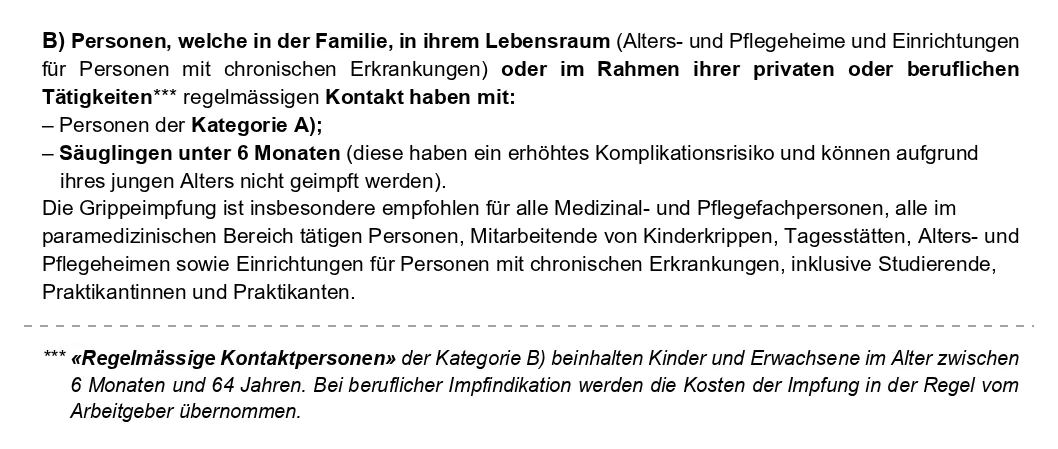
The reason is less your own protection than that of your patients and residents. The FOPH's high-risk group includes people aged 65 and over, pregnant women, people with chronic heart, lung or kidney disease or a weakened immune system, and everyone who lives in a care home. These are the people you look after every day. The vaccine isn't perfect: according to the federal flu vaccination page (in German), it is 20 to 80 percent effective against infection or a mild illness, depending on the season and the group, and it clearly lowers the risk of complications and death.
Hospitals are expected to play their part too. Swissnoso, the national centre for infection prevention, recommends in its guidelines on respiratory viruses that acute care hospitals offer their staff a flu vaccine. Offering isn't ordering. What an employer can do if you turn the offer down is governed by a different law.
A mask instead of the vaccine: what your employer can order
Your employer may introduce a mask rule for unvaccinated staff, as long as it's proportionate. The basis is its right to give instructions: the employer can issue directives on how the work is done and how staff behave at work, and you must follow them in good faith (Art. 321d CO). At the same time, it must protect its staff's health (Art. 328 CO), and it's also responsible for its patients and residents.
No law expressly allows or forbids a flu-season mask for unvaccinated staff. Swissnoso recommends considering a general mask rule depending on the local situation, for example in a severe flu season or during an outbreak, and then for everyone. A rule only for unvaccinated staff is a smaller step than a vaccine mandate, doesn't touch your body and only applies during the season. That's why, in a hospital or care home with vulnerable people, it's likely to be reasonable in most cases. Your employer has to provide the masks, like any other protective equipment (Art. 5 VUV, the accident prevention ordinance, in German), and you then have to wear them (Art. 82 UVG, the Accident Insurance Act, in German).
Rules like this aren't new. Two examples are publicly documented, both from newspapers and both a few years old.
Basel and Zofingen: masks during flu season
At University Hospital Basel, unvaccinated staff had to wear a mask in exceptional situations, Nau.ch (in German) reported in October 2017, citing a survey by the Basellandschaftliche Zeitung. We can't check whether the rule still applies today, because the hospital's hygiene guidelines are only available internally. According to a 2020 report by SRF (in German), Zofingen Hospital required all unvaccinated staff to wear a mask during flu season. Within five years, it had raised the vaccination rate among staff with patient contact from 23 to 53 percent, with regular information, training sessions, ways to give feedback and this very mask rule.
What applies at your workplace is set out in the staff regulations, a hygiene guideline or a notice before the season. If you hear nothing, ask. A mask rule for unvaccinated staff only works, however, if your employer knows who is vaccinated. That leads to the most delicate question.
Can your employer ask if you've had the flu vaccine?
Only if it needs the information for the work, and then it must treat it as specially protected data. An employer may only handle data about you insofar as it concerns your suitability for the job or is needed to perform the employment contract (Art. 328b CO). Whether you've had a flu vaccine is health data, and health data count as sensitive personal data (Art. 5 FADP).
On a ward with immunocompromised patients, your vaccination status may be needed for the work, for instance to apply a mask rule. In the accounts department, it hardly ever is. Even where the question is allowed, the principles of the Data Protection Act apply: your employer only collects what it needs for a specific purpose you know about, and deletes it as soon as it no longer needs it. Your consent gives it little legal cover. On its page on data processing by employers, the Federal Data Protection and Information Commissioner (FDPIC) notes that employees are very rarely in a position to give their consent freely, given their dependent position, and Art. 328b CO can never be departed from to your disadvantage anyway.
Who may see your answer
For medical examinations at work, the FDPIC draws a clear line: doctors, including the company's own, only tell the employer what matters for your suitability, never a diagnosis, and the file stays with them. Applied to the flu vaccine, in our view this means your proof of vaccination belongs with the occupational health service. Your ward manager only needs to know whether you wear a mask during the season. If you work in a cantonal or municipal hospital, your canton's data protection law often applies instead of the federal act.
You can ask your employer at any time, free of charge, what data it processes about you, for what purpose and for how long (Art. 25 FADP). The answer must come within 30 days, or within that time your employer must tell you when it will come (Art. 18 DPO). A short request is enough:
Subject: Request for information about my vaccination data
Dear Sir or Madam, under Art. 25 FADP, I am asking whether you process any information about my vaccination status and, if so, what information, for what purpose, who at the company has access to it and how long you keep it. Kind regards, [Name, staff number, department]
If you'd rather not answer, you don't have to. If there's a workplace rule that everyone without proof of vaccination wears a mask, you simply wear the mask. If you do get vaccinated, the main question is who pays the bill.
Who pays for the flu vaccine?
Usually your employer, and in any case not your health insurer. The health insurance benefits ordinance expressly excludes work-related vaccinations from basic health insurance (Art. 12a para. 3 KLV, in German). In the footnote to its recommendation, the FOPH writes that where the reason is work-related, the employer generally covers the cost, and the HUG say the same on their flu page (in French). We found no legal obligation to do so. It's simply common practice.
It's different if you belong to a risk group yourself, for example because you're pregnant, have a chronic illness or are 65 or older. Then, according to the FOPH, basic health insurance pays, provided you've already reached your deductible (franchise). During pregnancy, the FOPH recommends the flu vaccine anyway, regardless of your job.
If your employer doesn't offer the vaccine, ask it before you go to a pharmacy or doctor's practice whether it will cover the bill, and keep the receipt. If you work through a temp agency, the mask rule of the company you're placed with applies in your daily work, as described in our article on temporary and pool jobs. Settle the cost of the vaccine with the agency, though, because it's your employer. That leaves the question of when the vaccine does the most good.
When to get your flu vaccine
The best time, according to the FOPH, is from mid-October until the flu wave begins, which usually happens between mid-December and mid-March. Most often it starts in January. So a vaccine in November or December isn't too late, as long as the wave hasn't started yet.
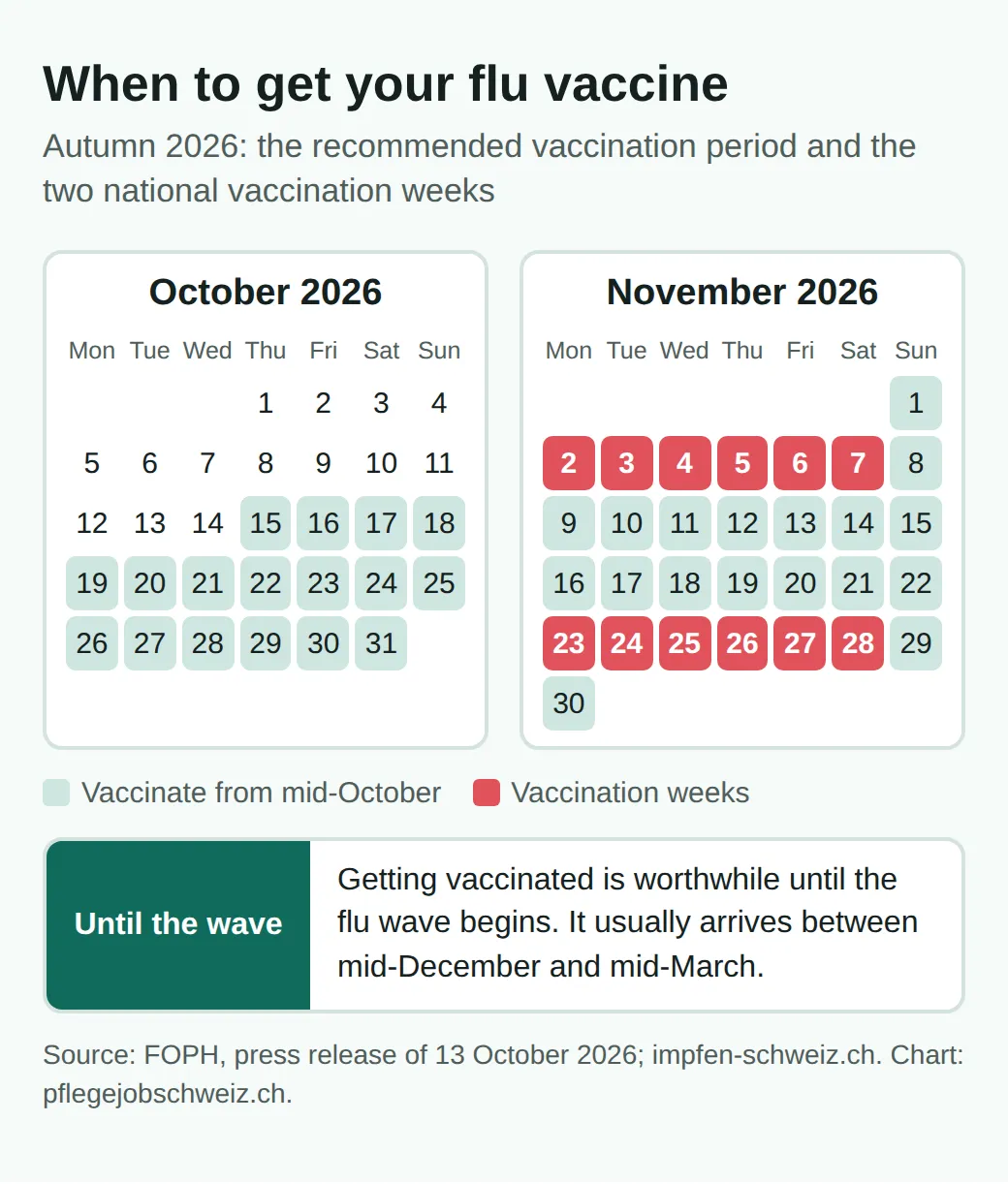
This autumn there are two national vaccination weeks: from 2 to 7 November and from 23 to 28 November 2026. At participating doctors' practices and pharmacies that vaccinate, you can get advice and be vaccinated against flu, Covid or RSV, usually by appointment, sometimes without one. The weeks are organised by the family doctors' Kollegium für Hausarztmedizin together with the Swiss Medical Association (FMH), the pharmacists' association pharmaSuisse and the FOPH. If your employer runs its own vaccination campaign, that's usually the easier route, because there the employer generally pays. The vaccination weeks are the answer if you missed the in-house date.
On 13 October, the FOPH pointed out that some flu vaccines are being delivered late, in Switzerland and across Europe. Even so, according to the FOPH, everyone who wants to be vaccinated should be able to get a dose before the wave. The federal government says the flu vaccine can be given on the same day as the Covid or RSV vaccine, in different arms.
Don't schedule the appointment right before a night shift. Common side effects are pain at the injection site, headache and tiredness, less often a fever, and they usually pass after one to three days. And if you decide not to get vaccinated, one last question remains.
If you turn the vaccine down
Then you bear the consequences your employer can lawfully attach to that, above all a mask rule. Dismissing you for that reason alone is legally risky. Notice is unlawful if it's given because someone exercises a constitutional right (Art. 336 CO), and that includes the right to physical integrity (Art. 10 of the Federal Constitution). The law makes one exception, though: when exercising that right breaches an obligation arising from the employment relationship or substantially impairs cooperation within the business. We found no court ruling on a dismissal over a refused flu vaccine, so how a court would decide depends on the individual case.
The closest comparable case was decided by the Zurich Labour Court (in German) in January 2024, though it was about Covid. An employee of a foundation recognised as a care home had refused the weekly tests that the canton of Zurich required care homes to carry out on unvaccinated staff, and had only partly followed the mask rule. The foundation dismissed him only after several meetings and a written warning. The court ruled that this dismissal was not unlawful. It held that ordinary notice for breaching legitimate instructions should as a rule not be unlawful, whereas notice for disobeying an illegal or disproportionate instruction would be. The High Court of the canton of Zurich upheld the ruling in principle in October 2024, after which the case went to the Federal Supreme Court. Applied to flu, then, what's likely to matter is not so much refusing the vaccine as whether you keep to the mask rule.
Moving you to other duties is only possible within limits, too. Swissnoso recommends considering duties without patient contact only for staff with respiratory symptoms on high-risk wards such as transplant units. There's no such rule for healthy, unvaccinated nurses. A different assignment within the terms of your contract is an instruction; different pay or a different role is a change to your contract and needs your agreement.
If you think a dismissal is unlawful, you have to act before the notice period ends. You object in writing to your employer (Art. 336b CO) and, if you can't reach an agreement, bring a claim within 180 days of the end of your employment. The court sets the compensation, up to six months' wages (Art. 336a CO). If you're employed by a canton or a municipality, check your employer's staff law first, as it may have its own rules on dismissal.
What to clarify before the season
In October, ask what your employer is planning: whether it offers a vaccination campaign and when, whether it has a mask rule for unvaccinated staff and from when it applies, and who records your vaccination status. If you want to be vaccinated, do it in the in-house campaign or at the latest during one of the vaccination weeks in November, and settle the cost before you go elsewhere.
If you don't want the vaccine, that's your right. Expect to wear a mask during the season, and keep to the rule, because it's the compromise the law allows. And if you're looking for a new job, read the conditions in the contract carefully: that's where a vaccine is most likely to become a requirement.
Common questions
- Do the same rules apply if I work through a temp agency?
- Yes, in day-to-day work. Your employment contract is with the temp agency, but the company you're placed with sets your rota and gives you instructions, so its mask rule applies to you too. It's best to agree with the agency who pays for the vaccine before your first assignment.
- Do nursing students and apprentices have to get the flu vaccine?
- No. As for everyone else, it's a recommendation, not an obligation. The FOPH names students and trainees in nursing explicitly as a target group. If the place where you train offers the vaccine, you can usually get it there free of charge.
- Can nurses work with a mild cold in Switzerland?
- According to the Swissnoso recommendations, yes, as long as you have no fever or your fever has gone. You then wear a surgical mask whenever you're in direct contact with other people and take your breaks alone if possible. With a fever or more severe symptoms, your workplace's own rules apply.
- Is the Covid vaccine recommended for healthcare workers in Switzerland?
- Not as a general rule. Swissnoso points out that there is currently no general recommendation for healthcare staff to be vaccinated against Covid. The FOPH recommends it from October for people aged 65 and over, pregnant women and people with certain pre-existing conditions or Down syndrome, whatever their job.
- What happens to my vaccination records when I change jobs?
- Your employer may only keep them for as long as it needs them for their purpose, and must then delete or anonymise them. You can ask free of charge what it has stored about you. It has to answer within 30 days.
More posts
All posts
Nursing Diploma Recognition in Switzerland: The SRC Process
Getting a foreign nursing diploma recognised by the Swiss Red Cross: steps, fees of CHF 680 to 1,130, timing, B2, compensatory measures, cantonal licence.

Pflegehelfer SRK 2026: Red Cross course cost, pay vs AGS
Swiss Red Cross nursing assistant course (Pflegehelfer SRK): cost in six cantons, what you may do, pay in Zurich, Bern and Lucerne, vs AGS and FaGe.

Return to Nursing in Switzerland 2026: Courses and Funding
Returning to nursing in Switzerland: which cantons pay for the refresher course, how to check GesReg and NAREG, and what onboarding to expect.