Return to Nursing in Switzerland 2026: Courses and Funding

In one minute
You can return to nursing in Switzerland without sitting a new exam. Employers hire returners on their old diploma, whether HF, AKP or DN II. A refresher course is voluntary, and many cantons pay for all of it or contribute CHF 4,000 to 5,000, as long as you apply in time. After that, what matters most is a good induction at your new workplace.
Each canton sets its own rules for course funding, and they differ more than the individual canton pages suggest. We've put the rules for Zurich, Bern, Aargau, St. Gallen, Thurgau and Central Switzerland side by side. We also draw on the Swiss Red Cross (SRC) register, the canton of St. Gallen's guide for employers and the Comeback study by Bern University of Applied Sciences. Almost all of these documents are published only in German, so most links below lead to German pages.
Do you need a course to go back to nursing?
No. The City of Zurich's health centres for older people say explicitly on their page for returners that the course run by the Swiss Nurses' Association (SBK) is not a requirement for a job. They hire returners with an HF, DN II, DN I, AKP, PsyKP, IKP, PKP or FaGe qualification. What they ask for is German at level B2 and a workload of at least 80 per cent during the probation period.
A course is often still worth it, because it gives you confidence. For its Comeback study, published in 2021, Bern University of Applied Sciences (BFH) talked to 14 women who had returned to nursing. Most needed about a year before they felt at home in the job again. What made the start hard was a short induction without anyone to support them, the fast pace of work, medical advances and digitalisation. You can catch up on some of that before your first shift.
Old qualifications count in full. In its funding framework, the canton of St. Gallen explicitly lists AKP, KWS, PsychKP, DN II and DN I alongside HF and FH (university of applied sciences) degrees. What actually happens on a course, though, varies a great deal.
What a return-to-nursing course covers
Courses last anywhere from eight days to a semester. They refresh your clinical knowledge, the nursing process and nursing skills, meaning the practical, hands-on work at the bedside. Three examples show the range.
SBK Zurich rebuilt its course in 2023 together with the canton, University Hospital Zurich and OdA Gesundheit Zürich, the body that organises healthcare training in the canton, according to the canton's press release. Three compulsory modules cover supervising trainees, the nursing process and documentation, and nursing skills: eight days in all. On top of that come up to ten days of optional modules and coaching, for job applications, for example. Through a "Marketplace" of selected employers, SBK also arranges one to three supported taster days in the care setting of your choice.
The OdA GS Aargau course in Brugg is longer. The next one runs from 22 February to 10 June 2027: ten preparation days with assignments, 15 days of classes and around 20 days of guided self-study. The school tailors the classes to the area you want to return to: long-term care, psychiatry, rehabilitation, home care (Spitex) or somatic care. In Central Switzerland, the XUND training centre puts together a programme from individual modules to fit what you need.
The St. Gallen funding framework sets out what a course must cover for the canton to pay for it: it takes place in Switzerland and deals with topics such as anatomy, the nursing process, electronic patient records, pharmacology and how different professions work together in a team. That's a useful yardstick for any course. Choose yours by the area you want to work in, because it will often be paid for anyway.
Who pays for the course
The canton and the federal government share the cost. The State Secretariat for Education, Research and Innovation (SERI) matches the canton's contribution, up to CHF 2,500 per person. The canton claims the federal money from SERI; you don't apply there yourself. So without a cantonal contribution, there's no federal one either.
Thurgau received the federal go-ahead in February 2024, under the new Federal Act on the Promotion of Training in Nursing. That's set out in the cantonal government's decision of May 2024. The act is part of the training drive that the federal government and the cantons fund for eight years, according to the Federal Office of Public Health (FOPH), with the second phase running from 2028 to 2032. The federal contribution to your course lasts as long as this act, so probably until 2032. What else the nursing initiative brings is covered in our post on implementing the nursing initiative.
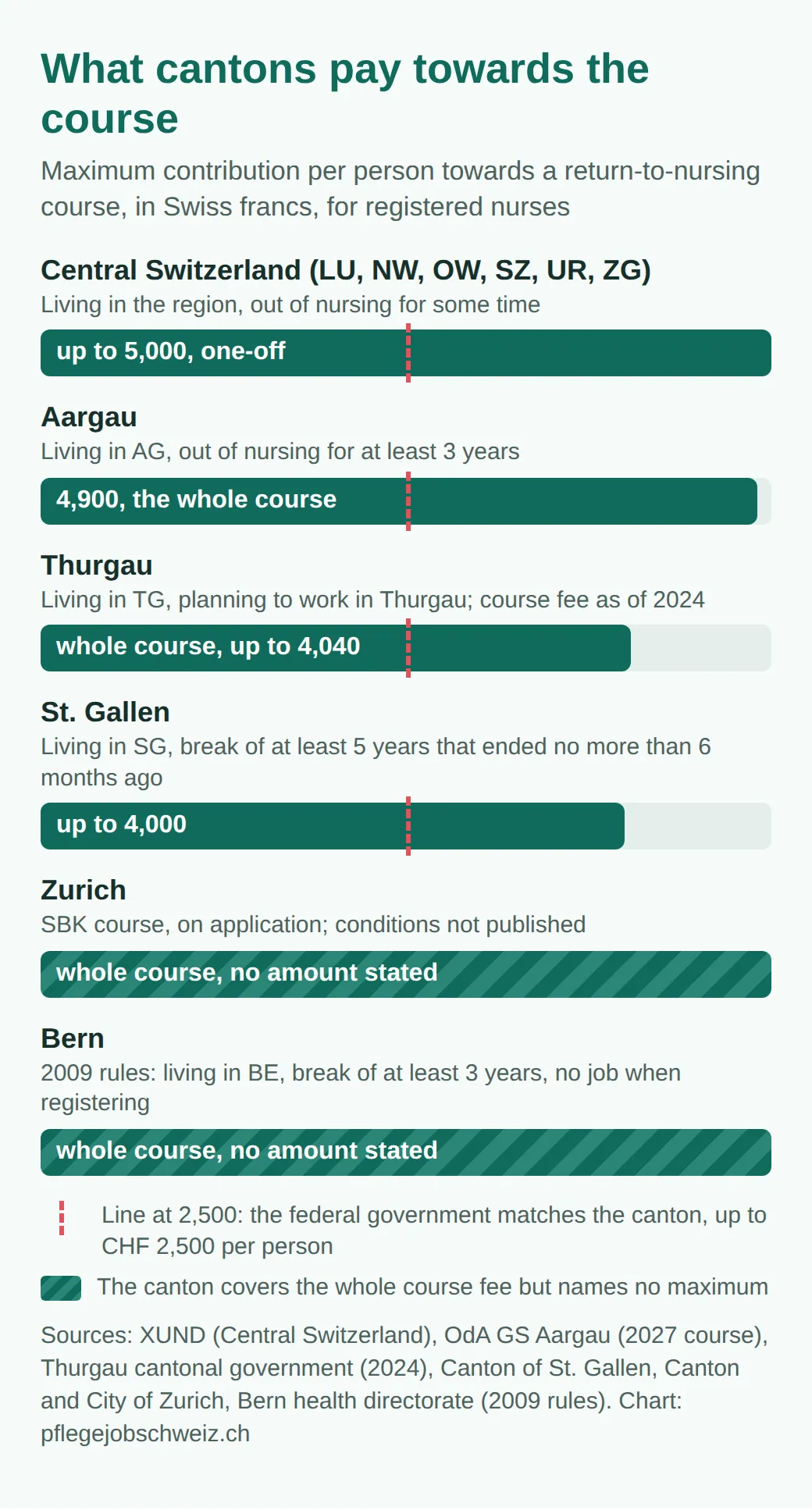
Almost everywhere, three conditions apply: you live in the canton, you intend to work there, and you've been out of nursing for a minimum period. And almost everywhere, the order is the same: apply first, then take the course.
Zurich: the whole course, on application
Since September 2023, the canton of Zurich has covered the full cost of the SBK course if "certain conditions" are met. What those conditions are appears neither in the canton's press release nor on SBK's course pages. The City of Zurich says the cantonal Health Directorate covers the costs on application, as of September 2025. If you don't qualify, SBK charges CHF 280 per course day. So before you register, ask SBK Zurich whether you meet the conditions.
Aargau: free after a three-year break
The course in Brugg costs CHF 4,900. It's free if you meet all of these conditions: a diploma as a registered nurse HF or an equivalent such as AKP, KWS, PsyKP or DN II, residence in Aargau, at least three years out of nursing, no more than six months in a job with a healthcare employer when you register, and the intention to work in Aargau. According to the canton's funding programme, registration closes ten days before each course starts.
St. Gallen: up to CHF 4,000, apply first
St. Gallen pays up to CHF 4,000 towards a course of your choice, half of it from the federal government. According to the canton's page, your break must have lasted at least five years and ended no more than six months ago. So if you've already been back at work for a year, you no longer qualify. You apply before the course, online through the canton's Medportal, using a federal AGOV login. After the course, the canton pays within 30 days. There's no obligation to stay in the canton afterwards. The budget, however, is planned for 15 people a year.
Thurgau, Bern and Central Switzerland
In Thurgau, the canton and the federal government each pay half from 1 August 2024 to 31 July 2032. According to the cantonal government, the only conditions are living in Thurgau and intending to work there. The course run by SBK St. Gallen-Thurgau-Appenzell cost CHF 3,030 for members and CHF 4,040 for everyone else in 2024. The school bills the cantonal health office directly.
In Bern, a 2009 rule from what was then the Health and Welfare Directorate applies, and the canton still lists it on its page about refresher courses. Whether it still applies unchanged is best checked when you register. The canton pays for the course if you've been out of the profession for at least three years, live in the canton of Bern and have no job with a healthcare employer when you register. The school submits the application for you. If you already have an employment contract, the canton expects your employer to pay, with a Revers. That's an agreement that you stay for a set period or else pay back part of the cost.
In Lucerne, Nidwalden, Obwalden, Schwyz, Uri and Zug, there's a one-off contribution of up to CHF 5,000. You need to live there, have been out of nursing for some time and want to return to work in Central Switzerland. You submit the application to XUND in the year of the course and send in the course certificate no later than ten days after it ends. Before you apply for jobs, it's worth looking yourself up in the register.
GesReg and NAREG: is your diploma registered?
You can check this yourself in a minute by searching under the name on your diploma. There are two registers with a shared search on nareg.ch, which you can switch to English. The federal healthcare professions register (GesReg) lists registered nurses HF, bachelor's degrees in nursing and recognised foreign qualifications. The cantons' National Register of Healthcare Professions (NAREG) lists diplomas obtained under earlier law, AKP for example. The SRC runs both.
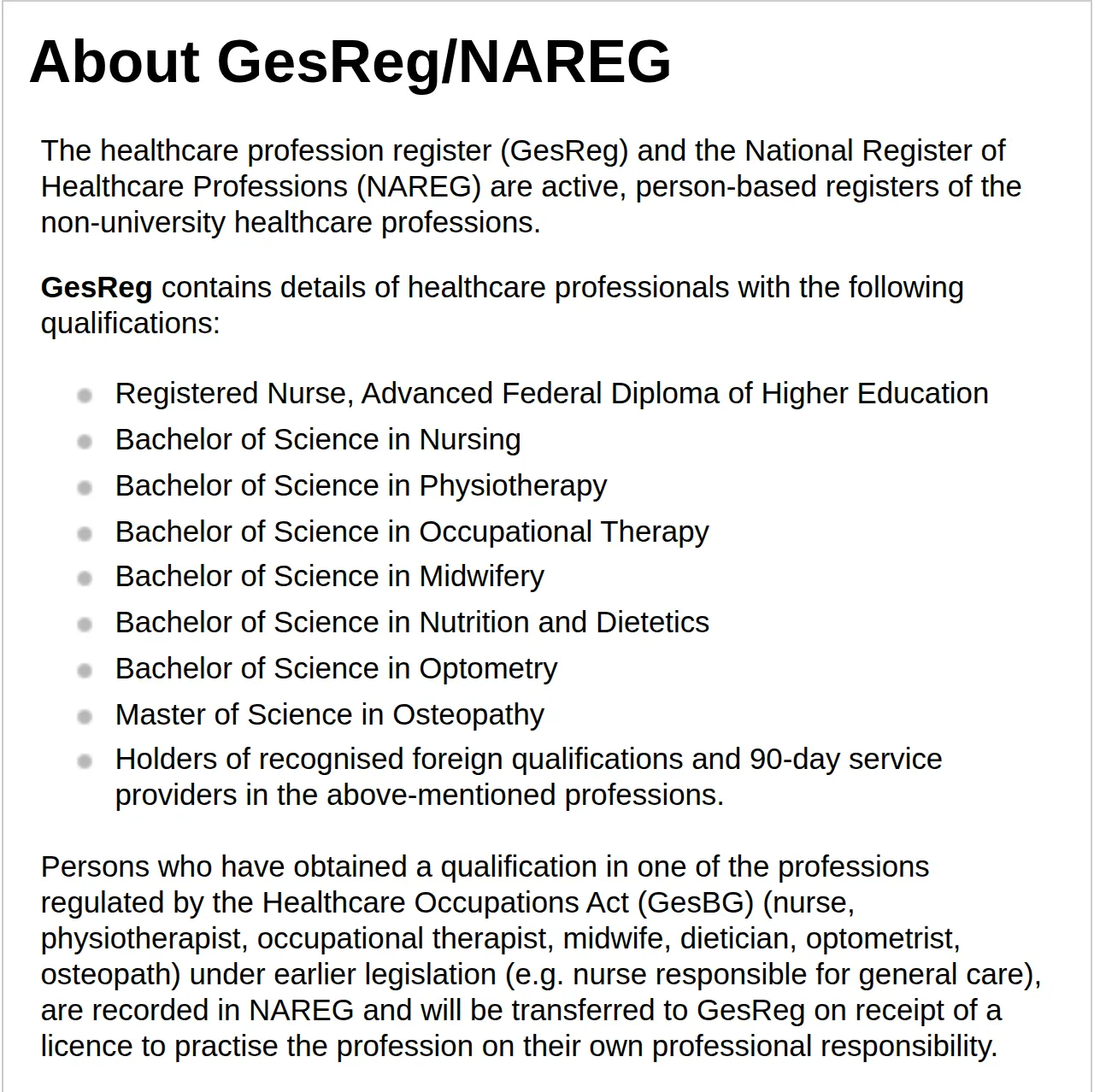
Authorities, health insurers and employers find key details about you there, the SRC explains. The data anyone can see, according to nareg.ch, include your name, former names, year of birth, nationality, profession and the date of your diploma. If you can't find yourself, contact the SRC. Registration costs a one-off CHF 130. If your name today differs from the one on your diploma, after a marriage for example, correct it with a change request. You'll find the link in the detailed view of your entry.
With an older Swiss diploma at tertiary level that the SRC has registered, you may use the protected title dipl. Pflegefachfrau HF or dipl. Pflegefachmann HF. The SRC issues a title certificate for this, for CHF 120. A DN I diploma has its own route to the title of registered nurse: you need two years of work experience at a workload of at least 80 per cent and further training of 280 lessons or 40 days. The procedure costs CHF 350, plus CHF 130 for the register. The Brugg course counts towards it. How the levels fit together today is explained in our post on FaGe, HF and FH.
You only need a licence from the canton if you work under your own professional responsibility, that is, without professional supervision by another nurse, for example as a self-employed nurse or a manager. If you work in a team under such supervision, you don't need one. With a foreign diploma, recognition comes first, which we describe in our post on recognition by the SRC. Once the paperwork is in order, your employer decides how well your return goes.
How employers onboard returning nurses
Good onboarding takes about three months and comes with a dedicated mentor. The canton of St. Gallen's framework for returning to practice shows what that can look like. It was written by specialists from St. Gallen's cantonal hospital, psychiatric services and geriatric clinic, from care homes, Spitex and SBK. It's a recommendation, not an obligation, and it describes what you're entitled to ask for.
At its centre is one person in the organisation who is responsible for returners. They hold at least an HF diploma, plan your onboarding and support you. The framework allows 10 to 15 per cent of a full-time post for this per returner. Day to day, a contact person from the team also looks after you, and the framework recommends paying them an allowance for it. From you, it expects German at level B2, ideally C1, openness to the organisation's software, and three months of onboarding at a workload of at least 50 per cent.
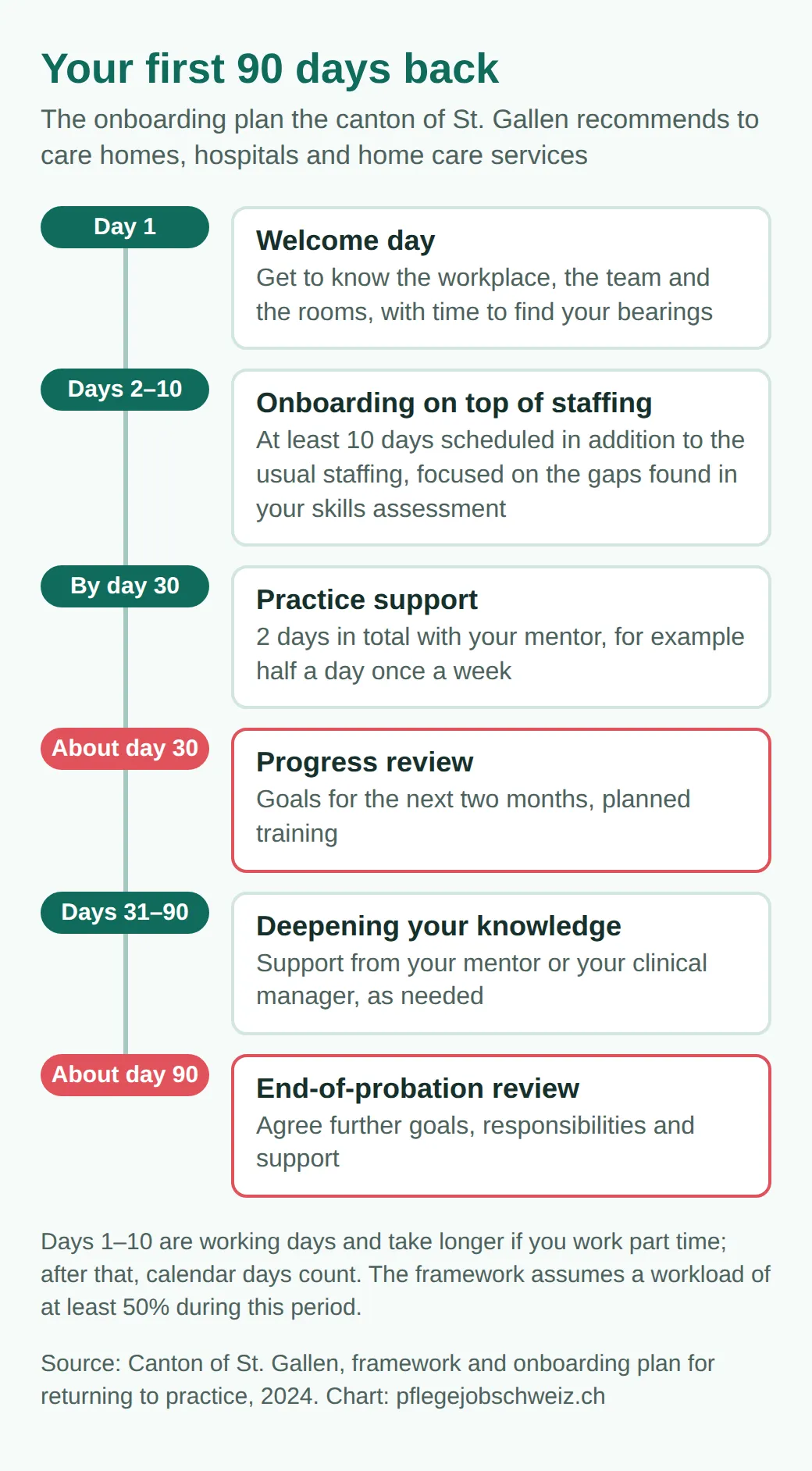
The most important part of the plan is days 2 to 10. During this time you should be supernumerary, scheduled on top of the normal staffing, so you don't yet count as a full member of the team. That's exactly what made the difference in the Bern study: some felt "thrown in at the deep end", while others had close support and remember their start fondly because of it. Almost all of them named continuous support as the deciding factor. The City of Zurich's health centres describe their approach in similar terms: individual support on the job and, if needed, courses at their own training centre. That leaves the question of pay.
Pay and workload when you return
The St. Gallen framework recommends hiring you at the level of your highest qualification. If the gaps after a long break are large, it advises against a lower grade and in favour of stepped pay rises: the steps are agreed in the contract, reviewed after three months, say, and you reach the intended salary after a year at the latest. Get this plan in writing. The City of Zurich quotes a starting salary from CHF 6,000 a month for registered nurses HF at 100 per cent. What the cantonal pay scales provide beyond that is in our post on pay for registered nurses HF.
On workload, it helps to know what the women in the Bern study found useful: a low workload, fixed working days and rotas that take your wishes into account. Being exempt from night shifts can also help people stay in the job, the study found. For onboarding, though, employers often require a minimum workload: 80 per cent at the City of Zurich, 50 per cent in the St. Gallen framework. Plan your first three months accordingly.
How to plan your return
Start with the register. Look yourself up on nareg.ch and get your name and diploma in order before an employer checks. Then find out what your canton of residence pays, and apply before you register for the course. In St. Gallen, you'd otherwise lose the contribution. In Central Switzerland, you apply in the year of the course, and in Bern what counts is that you don't yet have a job when you register.
A taster day tells you faster than any job ad whether an employer suits you. SBK Zurich arranges such days as part of its course, but you can also ask the director of nursing directly. Write in German: the job will be in German, and your email is the first sample of it. A short version:
Betreff: Wiedereinstieg in die Pflege, Anfrage für einen Einblickstag
Sehr geehrte Frau [Name], ich bin diplomierte Pflegefachfrau [HF, AKP oder DN II] und war seit [Jahr] nicht mehr in der Pflege tätig. Ich möchte im [Bereich] wieder einsteigen, mit einem Pensum von [Prozent]. Könnte ich einen Tag auf einer Ihrer Abteilungen mitarbeiten? Mich interessiert auch, wie Sie Rückkehrende einarbeiten und wer sie begleitet. Freundliche Grüsse, [Name, Telefonnummer]
It says that you're a registered nurse with your qualification, the year you last worked in nursing, the area and workload you'd like to return to, and asks whether you could spend a day working on one of their wards and how they onboard and support returners.
In the conversation afterwards, ask specific questions. Who will support me, and how much time do they have for it? How many days will I work on top of the normal staffing? When are the progress review and the end-of-probation review? And from when do I get the full salary? Clear answers are a good sign, because in the Bern study, support was what decided whether the start went well.
Common questions
- Do I have to pay back the course funding if I don't return to nursing?
- Not in St. Gallen: the canton's funding framework explicitly rules out any obligation or repayment. The other cantons whose rules we read say nothing on the point. So when you register, ask whether any condition is attached to the contribution.
- Can I get funding if I live in a different canton from where I want to work?
- Usually your place of residence is what counts. Aargau, St. Gallen and Thurgau also require that you intend to work in the canton, and Central Switzerland that you intend to work in the region. In Bern, your situation when you register decides, and moving later changes nothing. Ask the health department of the canton you live in first.
- Is there support for healthcare assistants (FaGe) returning to work?
- The federal contribution and most cantonal ones are only for registered nurses at tertiary level. For healthcare assistants with a FaGe qualification, the Central Switzerland office refers you to employers, who often run their own courses. The City of Zurich's health centres for older people hire returners with a FaGe qualification from CHF 5,030 a month at 100 per cent.
- Does time spent on a return-to-nursing course count as working time?
- Not automatically. The City of Zurich's health centres state explicitly that course time is not working time. If you already have a job, find out before you register whether your employer gives you the course days off or pays for them.
- Can I take a funded return-to-nursing course with a foreign nursing diploma?
- Yes, if your diploma is recognised in Switzerland. St. Gallen and Central Switzerland explicitly name a recognised foreign diploma as a requirement. Apply to the Swiss Red Cross for recognition before you apply for course funding.
More posts
All posts
Night shift and on-call pay for nurses in Switzerland (2026)
Night shift pay for nurses in Switzerland: 10% extra time off by law, 25% more for occasional nights, and the hourly allowances in Aargau, Solothurn and Zug.

Pflegehelfer SRK 2026: Red Cross course cost, pay vs AGS
Swiss Red Cross nursing assistant course (Pflegehelfer SRK): cost in six cantons, what you may do, pay in Zurich, Bern and Lucerne, vs AGS and FaGe.

FaGe or registered nurse? EFZ, HF and FH in Switzerland
FaGe EFZ or nurse with an HF or FH degree: what each may do, how long training takes, what it pays in Zurich and how to get from apprenticeship to diploma.