FaGe or registered nurse? EFZ, HF and FH in Switzerland

The short answer
A FaGe, short for Fachfrau Gesundheit or Fachmann Gesundheit, has completed a three-year apprenticeship with a Federal VET Diploma (EFZ). In English the role is often called a healthcare assistant. A FaGe provides care according to a care plan that a registered nurse is responsible for. A registered nurse holds a diploma from a college of higher education (HF) or a bachelor's degree from a university of applied sciences (FH). She makes nursing diagnoses, is responsible for the whole nursing process and, with a licence from the canton, may work on her own professional responsibility.
So HF and FH lead to the same profession, and the FaGe apprenticeship to a different one. What sets these qualifications apart is laid down in a handful of texts: the federal ordinance and training plan for the FaGe apprenticeship, the OdASanté framework curriculum for HF nursing, the federal competences ordinance for the bachelor's and the Health Professions Act. We also drew on pay recommendations from the Canton of Zurich and information published by four schools. Together they show you where the line runs in daily work, how long it takes to get from apprenticeship to diploma and what you earn along the way.
Three qualifications on two levels
The FaGe apprenticeship belongs to vocational education at upper secondary level, HF and FH to tertiary level. That is more than a formality: the framework curriculum for HF nursing requires an upper secondary qualification, an EFZ for example. The FaGe apprenticeship is therefore one possible foundation for nursing training, not its first part.
The ordinance on the FaGe apprenticeship (Bildungsverordnung, in German) sets it at three years. You spend three and a half days a week at your training company on average, plus 1,600 lessons at vocational school and 34 days of industry courses. The framework curriculum for HF nursing (Rahmenlehrplan Pflege HF) requires at least 5,400 hours of learning, which is three years full-time, half at school and half in practice. Work placements add up to 72 weeks. The bachelor's in nursing is worth 180 ECTS credits, six semesters full-time.
| FaGe EFZ | Nursing HF | Nursing FH | |
|---|---|---|---|
| Level | Vocational education (upper secondary) | College of higher education | University of applied sciences |
| Entry | Compulsory school | EFZ, specialised school certificate or Matura, aptitude assessment | Vocational, specialised or academic baccalaureate |
| Full-time duration | 3 years | 3 years, from 2 with FaGe | 3 years |
| Title | Fachfrau Gesundheit EFZ | dipl. Pflegefachfrau HF | Bachelor of Science in Nursing |
The numbers show how many people take each route. According to OdASanté's statistics, in 2024, the latest year with figures for all three qualifications, 4,751 people in Switzerland completed the FaGe apprenticeship, 2,240 the HF nursing diploma and 1,229 the FH bachelor's in nursing. That is just under one new HF nurse for every two new FaGe, and the HF colleges train almost twice as many nurses as the universities of applied sciences. What separates the three in the job is set out in their competences.
What a FaGe does and where the line is
A FaGe provides care and support independently, but within a plan she isn't responsible for herself. The OdASanté training plan (Bildungsplan) divides the job into eight areas. They range from personal hygiene, mobility and nutrition through end-of-life care to housekeeping, administration and logistics. One whole area covers medical and technical procedures, and that is where the line is drawn most precisely.
A FaGe learns to check vital signs, take venous and capillary blood samples, prepare and give medication, and give subcutaneous and intramuscular injections. She prepares and connects infusions without added medication, but only when an IV line is already in place. She may change infusions that already contain medication; adding medication isn't in the training plan. She gives tube feeding through an existing feeding tube. The word "existing" is in the training plan for a reason: someone else puts the line or tube in.
The ordinance also says how far that independence goes. A FaGe works "independently within the scope of the competences acquired, the legal framework and the employer's rules". And the training plan requires her to know when to call in the responsible professional. So what a hospital or care home actually lets its FaGe do is decided by the employer.
The model job descriptions published by the Canton of Fribourg (in German) show what this looks like in practice. The FaGe carries out care "according to the existing care plan" and takes on specific tasks "on behalf of and under the supervision of a registered nurse". Even the experienced FaGe at the higher level, with at least five years in the job, cares for people who are stable or have chronic conditions and contributes to their care plan. Contributes is the verb there. Responsibility for the plan lies elsewhere.
What a registered nurse is responsible for on top
The registered nurse is responsible for the whole nursing process, from assessment to evaluation. The HF framework curriculum breaks the profession down into ten work processes. They start with assessment, the systematic recording of a person's physical, mental and social situation, and the nursing diagnosis. Then she plans the care, carries it out or delegates it, monitors it and checks whether it works. The job also covers leadership, supervising apprentices and students, and organising the ward.
For the bachelor's, the competences are even set out in a federal ordinance. Under Article 2 of the Health Professions Competences Ordinance (GesBKV, in German), graduates must be able to carry out clinical examinations and take patient histories, assess care needs and make nursing diagnoses. One sentence fits the relationship with the FaGe exactly: they take professional responsibility for the nursing process "towards members of their own professional group with other qualifications".
In daily work the two roles mesh. The FaGe gives prescribed medication, carries out medical and technical tasks to the employer's standards and immediately reports any change in a patient's condition, as the Fribourg job description puts it. The registered nurse reassesses the situation, adjusts the plan and consults doctors and therapists. The framework curriculum expects her to act with a clear head even in critical, complex and fast-changing situations. This division of labour has a legal side too.
The legal difference: the licence
If you provide care on your own professional responsibility, you need a licence from the canton, and you only get one with an HF or FH qualification. That is set out in Articles 11 and 12 of the Health Professions Act (Gesundheitsberufegesetz, in German). The Act counts nurses among the health professions; the FaGe is not one of them.
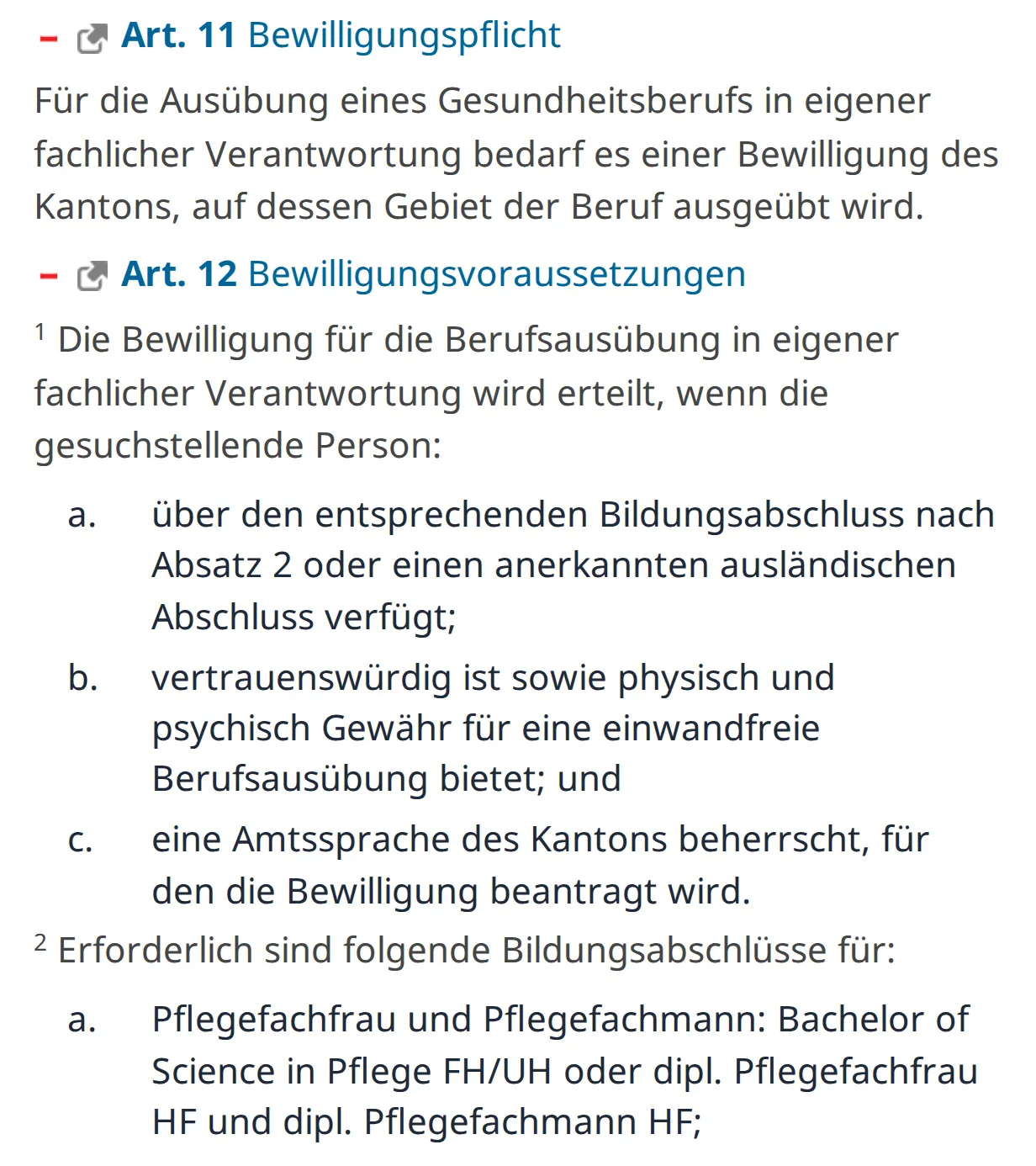
If you are employed, the licence doesn't matter as long as you work under the professional supervision of a registered nurse. It becomes important when you want to be self-employed or take a post without a professional superior. For a FaGe that door is closed; for a nurse with an HF diploma it is just as open as for one with a bachelor's. How the licence works with a diploma from abroad is explained in our post on the recognition of nursing diplomas. What the nursing initiative changes about the role of registered nurses is covered in our article on implementing the nursing initiative.
HF or FH: same profession, different route
In the job, HF and FH have equal standing; in training, they don't. The law requires one or the other for the licence, with no ranking. The Berner Bildungszentrum Pflege and Bern University of Applied Sciences (BFH) sum up the difference in their joint HF and FH comparison (in German): at an HF you spend half your time in practice, while at an FH 70 percent goes on background knowledge. After an FH degree you should also be able to work scientifically and bring research into practice. Both schools write that what counts is having a mix of both routes in the team.
Entry requirements differ more. You get into an HF with an upper secondary qualification, meaning an EFZ, a specialised school certificate or a Matura, and a passed aptitude assessment. The Zurich school ZAG requires a three-year apprenticeship with an EFZ and German at level C1. For an FH you need a baccalaureate, which for a FaGe means the vocational baccalaureate. If you haven't trained in a health profession, ZHAW asks for up to twelve months of extra practical experience depending on your background, at least two of them before you start. With an EFZ and a vocational baccalaureate in health, you are admitted directly there and don't need to prove any extra practical experience. BFH likewise credits a FaGe with a vocational baccalaureate with the required two months of work experience.
Since 1 October 2026, there has been a new addition to the HF title. According to the State Secretariat for Education, Research and Innovation, SERI (in German), nurses with an HF diploma may add "Professional Bachelor" after their protected title, separated by a comma, even with a diploma from earlier years. That doesn't turn it into a university bachelor's degree: the addition has no bearing on admission to other programmes, which is still decided by the university. If you want a master's in nursing, at BFH you first complete the bachelor's.
Not every employer distinguishes between HF and FH on pay. In the Canton of Zurich's grading plan for children's and youth homes (Einreihungsplan), registered nurses are in salary classes 13 to 17, with no distinction between HF and FH, and the FaGe in classes 9 to 13. According to the 2026 pay table, the lowest step of class 13 is CHF 69,005 a year, that of class 9 CHF 57,160. Other employers have their own systems. What nurses with an HF diploma earn in hospitals, care homes and home care is covered in our post on HF nurse salaries. For a FaGe, a different question comes first: how long the switch takes.
How long does it take to go from FaGe to registered nurse?
With the FaGe apprenticeship as your foundation, you can be a registered nurse with an HF diploma five years after leaving school at the earliest. Colleges of higher education credit the apprenticeship and shorten the HF programme to two years, according to the Berner Bildungszentrum Pflege for full-time FaGe students. The Zurich school ZAG admits FaGe after an admission procedure: an aptitude test, a trial placement, a portfolio and an interview. The school then decides whether you join the two-year or the three-year programme.
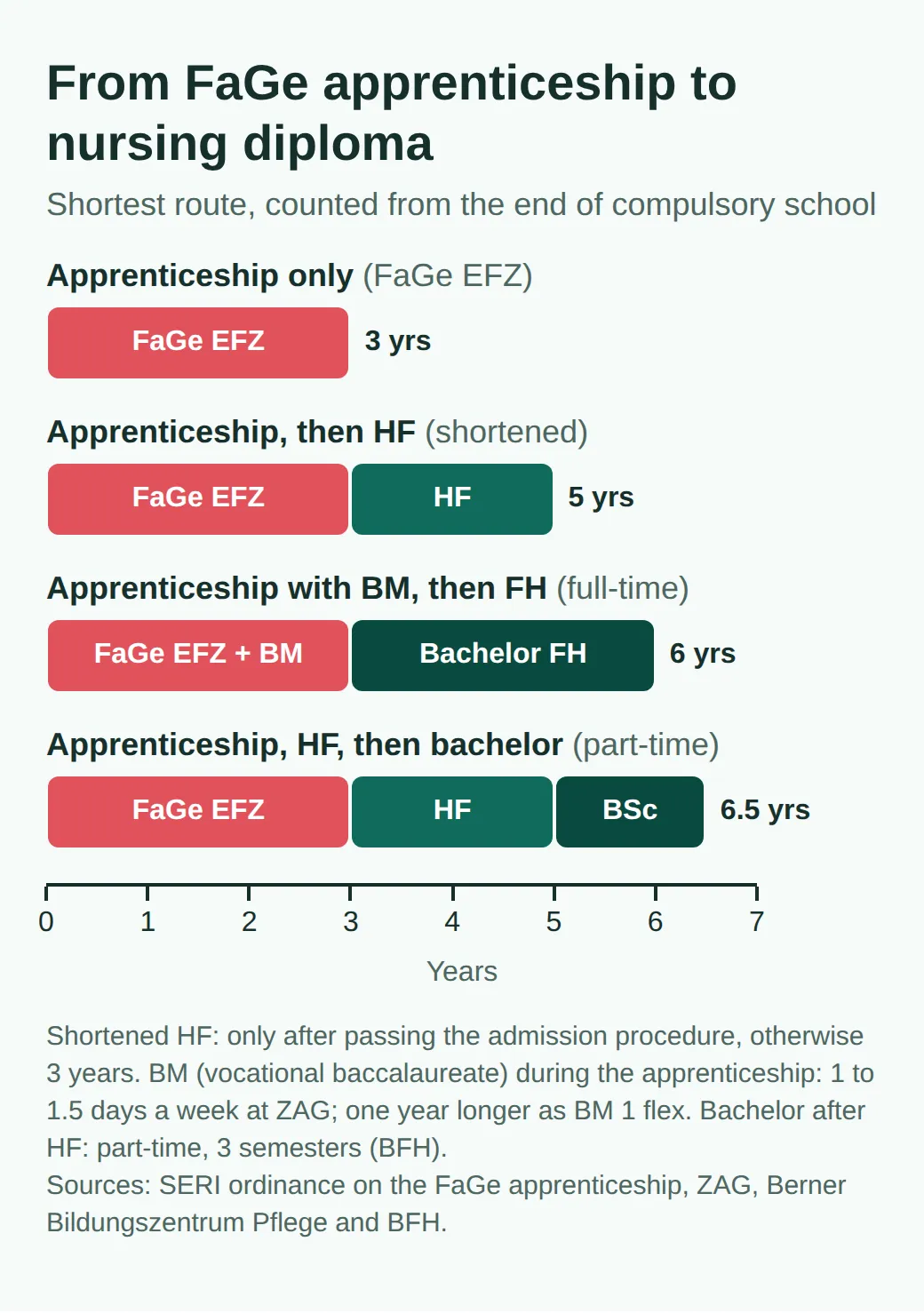
There are two routes to the bachelor's, and they are only half a year apart. The fastest is to take the vocational baccalaureate during your apprenticeship: at ZAG, FaGe apprentices attend the vocational baccalaureate school on top, one day a week in the first year and one and a half days after that. With the three-year full-time degree, you are there after six years. The BM 1 flex option spreads the vocational baccalaureate over four years and takes one year longer. Via the HF and BFH's part-time bachelor's programme, which takes three semesters for nurses with an HF diploma, it is six and a half years. BFH recommends working around 50 percent alongside it, so by then you are already working with your diploma.
If you want to study while you work, there are also part-time HF programmes. The framework curriculum requires you to be employed in nursing at least 50 percent and generally limits them to four years. Adults can become a FaGe too: with at least two years of experience in care and support, you can start directly in the second year of the apprenticeship at ZAG after an individual assessment. A qualification as a health and social care assistant (Assistentin Gesundheit und Soziales EBA) also makes a shortened apprenticeship possible. You earn money on every one of these routes, but very different amounts.
What you earn while you train
In the Canton of Zurich, an HF student earns roughly two to four times as much as a FaGe apprentice in the same year of training. OdA Gesundheit Zürich recommends CHF 800 a month in the first year for FaGe apprentices (in German), 1,000 in the second and 1,400 in the third, plus a 13th salary. For HF students at cantonal employers, it is CHF 2,200 to 4,166.67 a month depending on age and year of training, with the 13th salary included. Both are recommendations; employers set the pay themselves.
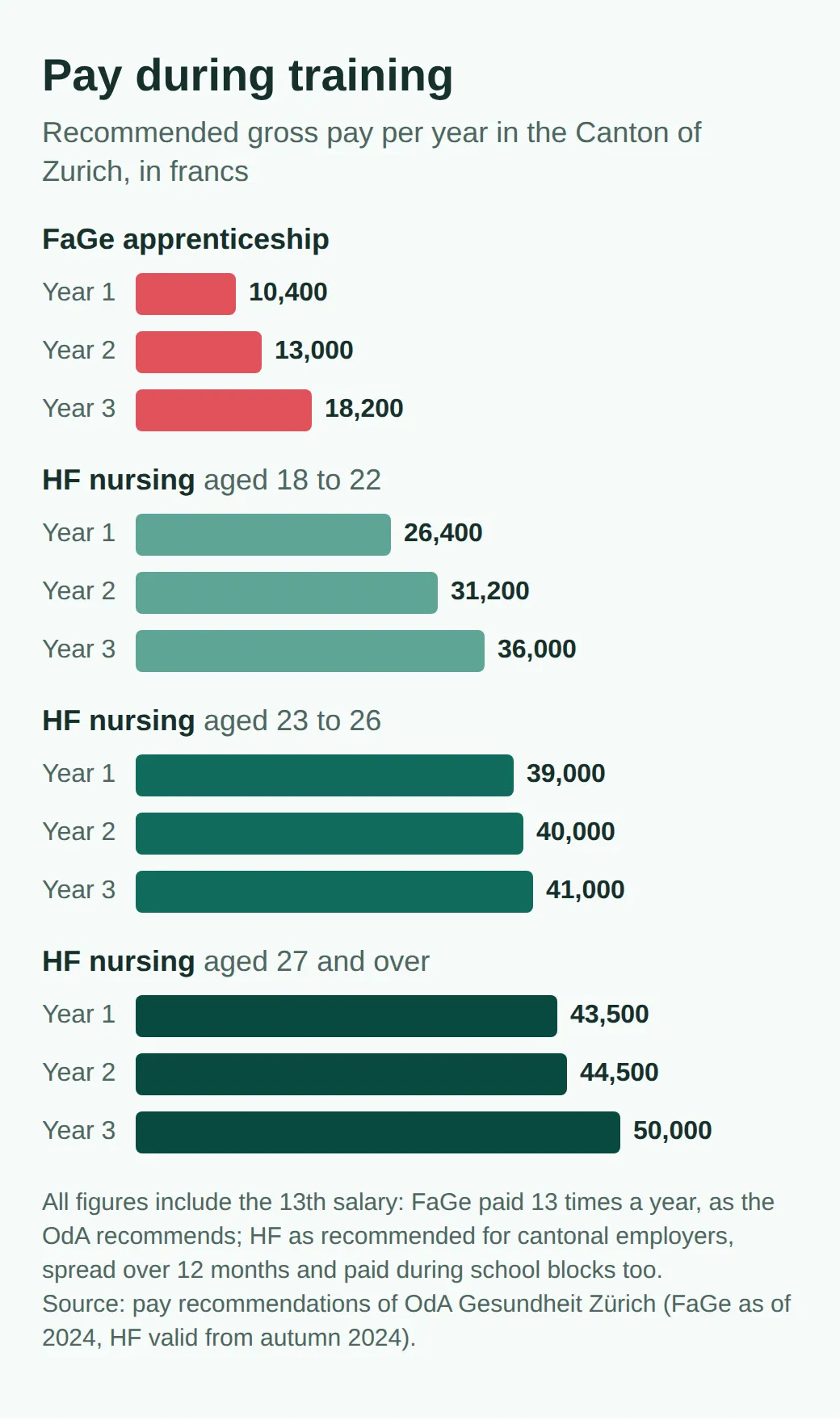
The gap is bigger than it looks at first. HF pay runs for twelve months, so it continues during the blocks at school. At an FH, by contrast, you are only paid during work placements; ZHAW gives the same range for Zurich, CHF 2,200 to 4,166 a month. And HF pay rises with age: if you start at 27 or later, you get CHF 43,500 in the first year, almost two and a half times as much as a FaGe in the third year of the apprenticeship with the 13th salary (CHF 18,200). So if you work as a FaGe for a few years and then move to an HF, you don't drop back to an apprentice's wage.
The canton adds money on top. Zurich pays HF and FH nursing students a training allowance (Förderbeitrag, in German) of CHF 500 a month, CHF 700 from age 30, and CHF 100 more for each child who is under 18 or still in education. To qualify you must be at least 21, live in the Canton of Zurich or hold a cross-border commuter permit there, and not yet have an HF nursing diploma. For a course starting in autumn, you apply between 1 April and 31 July. Tuition fees at the universities of applied sciences are modest: if you live in Switzerland, BFH charges CHF 850 a semester and ZHAW CHF 720.
FaGe apprenticeships
The FaGe apprenticeship starts with an apprenticeship contract: the employer, not the school, chooses its apprentices and sets their pay. You'll find open apprenticeships in hospitals, care homes and home care on our job board.
Jobs in the Canton of Zurich
The pay figures above apply to Zurich; other cantons have their own recommendations and allowances. Here are open jobs for FaGe and registered nurses in the Canton of Zurich.
Which route suits you
If you want to go straight into nursing after school, start with the FaGe apprenticeship. It doesn't close any doors: the HF credits it, and with a vocational baccalaureate a university of applied sciences is open to you too. If you already have a Matura, you choose between the HF, with pay throughout your training and a lot of practice, and the FH, with a more academic focus and the route to a master's. In the job, both take you to the same place.
If you already work as a FaGe, first ask your employer whether it trains HF students, and sign up early for a college's admission procedure. At ZAG, a passed aptitude assessment stays valid for three years. Factor in your age: from 27, OdA Gesundheit Zürich recommends a much higher training wage, and from 30 the canton's allowance goes up. You can apply for it before your training starts. And if you want to stay in nursing without carrying responsibility for the nursing process, the FaGe role is exactly right for you.
Common questions
- As a FaGe, can I call myself a nurse in Switzerland?
- No. Your title is Fachfrau Gesundheit EFZ or Fachmann Gesundheit EFZ, a healthcare assistant with a Federal VET Diploma. The title dipl. Pflegefachfrau HF is protected and reserved for graduates of a nursing programme at a college of higher education (HF). The Bachelor of Science in Nursing is reserved for graduates of a university of applied sciences or a university.
- Is there a qualification between FaGe and HF nursing?
- Yes, through a federal professional examination. The OdASanté overview of health qualifications lists, among others, the Federal PET Diplomas in long-term care and support and in psychiatric care and support. They deepen one field of work, but they don't make you a registered nurse and don't give you a licence to work on your own professional responsibility.
- Is the new Professional Bachelor title the same as a bachelor's degree?
- No. Since 1 October 2026, nurses with an HF diploma may add Professional Bachelor after their title, even if they qualified years ago. SERI states that the addition has no effect on admission to other programmes: whether you are admitted to a bachelor's or master's degree is still up to the university. At BFH, the route to a master's in nursing runs through the bachelor's, which HF nurses can complete there in a shortened part-time programme.
- Can adults become a FaGe without an apprenticeship contract?
- Yes, through a validation procedure. You document your work experience and skills in a portfolio and make up any missing competences in modules, with no apprenticeship contract needed. In Zurich, ZAG offers this to people employed in healthcare and asks for German at level B1. ZAG names no age limit.
More posts
All posts
Pflegehelfer SRK 2026: Red Cross course cost, pay vs AGS
Swiss Red Cross nursing assistant course (Pflegehelfer SRK): cost in six cantons, what you may do, pay in Zurich, Bern and Lucerne, vs AGS and FaGe.

Return to Nursing in Switzerland 2026: Courses and Funding
Returning to nursing in Switzerland: which cantons pay for the refresher course, how to check GesReg and NAREG, and what onboarding to expect.

Night shift and on-call pay for nurses in Switzerland (2026)
Night shift pay for nurses in Switzerland: 10% extra time off by law, 25% more for occasional nights, and the hourly allowances in Aargau, Solothurn and Zug.