Night shift and on-call pay for nurses in Switzerland (2026)

The short answer
Swiss law sets no fixed night allowance in francs. If you work nights regularly, the Labour Act gives you 10 percent of your night hours back as extra time off. Only if you work fewer than 25 nights a year do you get 25 percent more pay instead. Cash per hour comes from collective agreements and staff regulations: CHF 5.75 to 12 in our examples.
These two levels often get mixed up, so we keep them apart here. First, what the law guarantees every nurse it covers. Then, what three hospital groups and the Canton of Zurich actually pay, worked out for an ordinary night shift from 22:00 to 07:00. Weekends and on-call duty come at the end, because different rules apply to them.
What the Labour Act counts as night
Under the Labour Act, night is the time from 23:00 to 06:00. Day work runs from 06:00 to 20:00 and evening work from 20:00 to 23:00, as set out in Article 10 of the Labour Act. The current versions of the act and its ordinances exist only in German, French and Italian, so our links go to the German text. With the staff's consent, an employer can shift these limits by one hour at most, according to SECO's page on night and Sunday work. The legal night therefore always lasts seven hours, for example from 22:00 to 05:00.
Hospitals, care homes and home care services (Spitex) need no permit for night and Sunday work (Art. 15 to 17 ArGV 2). That makes planning easier, but it doesn't change what you're owed: compensation for night work applies in these workplaces too, as SECO stresses in its information sheet on the time supplement. Hospitals may also schedule longer night shifts. Instead of nine hours within a span of ten, the night shift may fall within twelve hours, provided twelve hours of rest follow and you have somewhere to lie down. You then work no more than ten hours, with a large share of on-site standby time, or no more than eight hours, with all twelve counted as working time (Art. 10 para. 2 ArGV 2).
Whether the Labour Act applies to you depends on your employer's legal form. Private clinics, private care homes and hospitals run as limited companies (AG) are covered, and so are public-law institutions with their own legal personality. Hospitals that are part of the cantonal or municipal administration are not bound by its rules on working and rest hours (Art. 2 ArG). Nor are public-law institutions without their own legal personality, as long as most of their staff are employed under public law (Art. 7 ArGV 1). There, the canton's or municipality's staff law applies. For everyone else, compensation starts with a single number.
The 10% time supplement
If you work 25 or more nights in a calendar year, you do regular night work. For that you get 10 percent of your night hours as extra paid time off (Art. 17b para. 2 ArG and Art. 31 ArGV 1). If night work is planned that way from the start, you're entitled from the very first night. SECO explicitly names night staff in care homes and nursing assistants regularly rostered on nights as examples.
The calculation uses the hours you actually work within the seven night hours. A shift from 22:00 to 07:00 covers seven legal night hours and earns you a 42-minute credit. The break counts if you may not leave the ward, or if you can be called back from your break without being able to make it up later. That is what SECO's guidance on the Labour Act says under Article 31. Work 80 such nights a year and you reach 56 hours, more than a full 42-hour working week.
You must take the supplement as time off within a year, and it must appear separately in your time records. Your employer may pay it out in cash only when your employment ends. The one other exception concerns people who work only one hour at the edge of the night, say from 05:00 to 06:00: they may receive a 10 percent pay supplement instead. You can't waive the supplement, not even in writing, and according to the information sheet your employer can't simply raise your weekly hours by the amount of the supplement either. If you're paid by the hour, you get the 10 percent as paid time off.
A pay supplement doesn't replace the time off. If a collective agreement only provides money for regular night work, in SECO's example 15 percent more pay, the time supplement is still owed on top. Time credits from a collective agreement, on the other hand, may be counted towards it. The hospital agreements below grant 20 or 25 percent in time and so more than cover the legal minimum.
When the time supplement does not apply
The law has three exceptions. No time supplement is owed if shifts in the workplace last seven hours or less on average, breaks included. Nor is it owed if night workers are only rostered on four nights a week. And finally, none is owed if a collective agreement or public-law rules provide equivalent compensation that SECO has recognised. According to SECO's guidance, public-law rules applied this way are common in healthcare and care homes.
The first two exceptions are narrower than they sound. They require a whole working-time system with no more than 35 hours a week for seven-hour shifts, or no more than 36 hours for the four-night week, in each case as a full-time workload (Art. 32 ArGV 1). Part-time staff may then only work a proportional share, so at 80 percent that means 3.2 nights a week. If you work four nights a week at 80 percent, you're owed the supplement.
A case from the canton of Zug shows what this looks like in nursing. A private clinic rostered its night staff, qualified nurses and support staff alike, on a four-day week of 36 hours and gave them no time supplement. In 2006 the clinic asked the cantonal Office for Economy and Labour (Amt für Wirtschaft und Arbeit) to review its model, and shortly afterwards the public services union VPOD filed a complaint against it. The office, the cantonal government and the cantonal administrative court all sided with the nurses. In March 2009 the Federal Supreme Court overturned that decision and sent the case back (ruling 2C_308/2008). The four-night week didn't have to apply to day staff as well, the court said, but it did have to apply to everyone working nights regularly. And it had to be a full-time workload: 36 night hours had to be paid the same as a full-time day post, which at this clinic meant 40 hours in nursing. We could not find the administrative court's new decision.
For your contract, this means a four-night week without a time supplement is only correct if you're paid a full-time salary for it. It's a different story if you only cover the odd night.
Occasional night shifts: 25% more pay
If you work fewer than 25 nights a year, that counts as temporary night work. Your employer then owes you a pay supplement of at least 25 percent for the night hours (Art. 17b para. 1 ArG). This applies, for example, to day-shift nurses who now and then step in on nights for a sick colleague.
The 25 percent is a minimum. If your contract offers less, your employer must pay the difference. An example: on an hourly wage of CHF 40, 25 percent is CHF 10 per night hour. If your contract only promises 15 percent, or CHF 6, you're short CHF 4 for every hour between 23:00 and 06:00, which is CHF 28 for a whole night.
If it turns out during the year that you'll work 25 nights or more after all, your entitlement switches to the time supplement from the 25th night at the latest. You keep the pay supplement for the earlier nights (Art. 31 para. 3 ArGV 1). So much for the law. In hospitals with a collective agreement, money comes on top, and for every night shift.
What hospitals actually pay
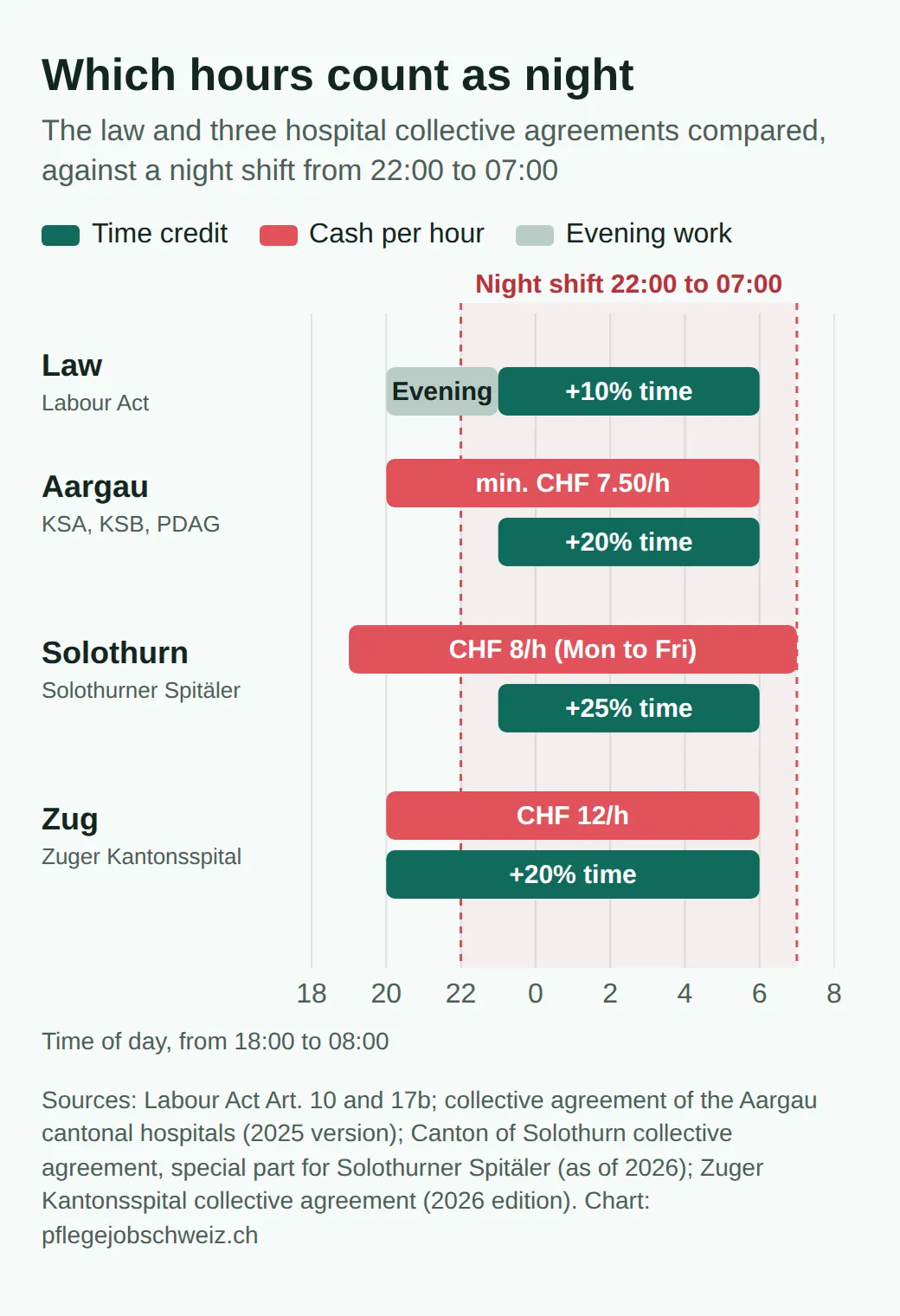
The allowance in francs is set by the collective agreement or the staff regulations, and these differ not only in the amounts but also in the hours they cover. We read three current collective agreements of public hospitals. The chart shows which hours count in each.
Aargau: at least CHF 7.50
Kantonsspital Aarau, Kantonsspital Baden and Psychiatrische Dienste Aargau share one collective agreement of the Aargau cantonal hospitals, in its current version since 1 January 2025. For work between 20:00 and 06:00, and on Saturdays, Sundays and public holidays as rostered, it pays at least CHF 7.50 an hour (section 6.8 and appendix A2.1). On top comes a time supplement of at least 20 percent for work between 23:00 and 06:00 (section 3.7), double the legal minimum. Since the agreement sets minimum amounts, it's worth asking whether your hospital pays more.
Solothurn: CHF 8 and 25%
Solothurner Spitäler AG falls under the canton's collective agreement, but has had its own, higher rates since 2023. It requested them in November 2022 as an emergency measure against the acute shortage of skilled staff and to stay competitive with other hospitals. The cantonal government confirmed the change on 31 January 2023, backdated to 1 January. The current agreement, in force since 1 January 2026, gives hospital staff CHF 8 an hour for work from Monday to Friday between 19:00 and 07:00, and around the clock on Saturdays, Sundays and public holidays (§ 259ter). On top comes a 25 percent time supplement for work between 23:00 and 06:00 (§ 259bis). Other cantonal staff receive CHF 6.50 and 20 percent.
Zug: CHF 12 an hour
The highest payer in our comparison is Zuger Kantonsspital AG. Since January 2024 it has paid CHF 12 instead of CHF 8.50 an hour, as agreed with the unions VPOD and Syna and the Swiss Nurses Association (SBK), the hospital announced in a press release. The 2026 collective agreement confirms the amount for work between 20:00 and 06:00 and on Saturdays, Sundays and public holidays (section 5.11). The allowance is paid only once per hour, even when a night hour falls on a Sunday. For the same window from 20:00 to 06:00 you also get a 20 percent time supplement (section 4.7), so here the time supplement starts three hours earlier than under the law.
Canton of Zurich: CHF 5.75 under staff law
For employees of the Canton of Zurich, the implementing ordinance to the cantonal Personnel Act applies: CHF 5.75 an hour for regular night, Saturday, Sunday and shift work, or CHF 6.40 to 6.60 with the holiday supplement, according to the Finance Department's directive. The night starts at 20:00 there, as the University of Zurich explains in its information sheet on the same allowances. The cantonal hospitals have their own staff regulations and may depart from staff law in favour of nursing staff, including higher allowances for night, weekend and on-call duty, as the cantonal government wrote in a 2022 report to the cantonal parliament. You'll find examples from Lucerne, Fribourg and Bern in our article on salaries for registered nurses (HF). What these differences add up to over a month only shows in a worked example.
One night shift, calculated four ways
Take seven night shifts a month, all on weeknights and each from 22:00 to 07:00. The break counts as working time because you may not leave the ward. Under the law you get no money for this, but 42 minutes of time off per night, or 4 hours 54 minutes a month.
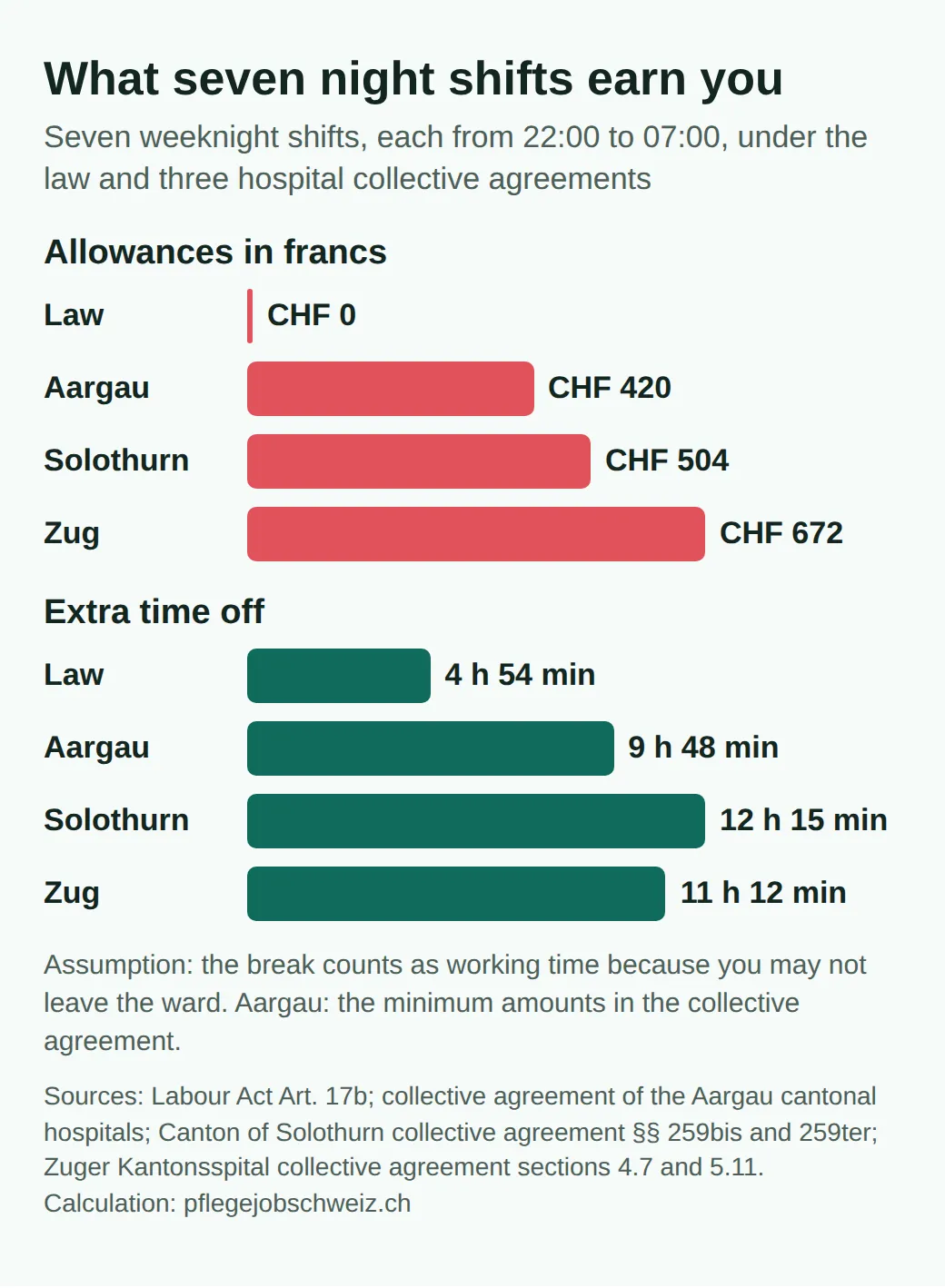
In the three hospitals the sums look different. In Aargau, the eight hours until 06:00 count for the cash, which makes at least CHF 60 a night, and for the time it's seven hours at 20 percent. In Solothurn all nine hours count, because the window runs until 07:00: CHF 72 a night. In Zug it's eight hours at CHF 12, so CHF 96, and because the time supplement starts at 20:00, also eight hours at 20 percent.
Over seven nights, the Aargau minimum and Zug are CHF 252 a month apart. On time off, the law and Solothurn differ by more than seven hours, almost one more night shift. All amounts are gross. Allowances are taxable income just like your salary (Art. 17 DBG). If the night falls on a weekend, little changes in these three hospitals. Elsewhere, the weekend can be exactly what makes the difference.
Is there extra pay for weekend shifts?
For Sundays, only if they stay the exception. If you work no more than six Sundays or public holidays a year, that counts as temporary Sunday work and earns a 50 percent pay supplement (Art. 19 para. 3 ArG and Art. 32a ArGV 1). If you work Sundays regularly, as many nurses on rotating shifts do, the law entitles you to rest, not money. Hospitals must give you at least twelve Sundays off a year and, in the week of a Sunday shift or the following week, 36 consecutive hours off immediately after your daily rest period (Art. 12 para. 2 ArGV 2).
Legally, Saturday is a working day. Neither the Labour Act nor the collective agreements of the Basel hospitals require a supplement for it, the Basel-Stadt cantonal government noted in January 2026. Its survey shows how differently employers handle this: University Hospital Basel and Universitäre Altersmedizin Felix Platter voluntarily pay CHF 3.50 an hour, the University Children's Hospital Basel (UKBB) and the Merian Iselin Klinik CHF 10, several others nothing. In Aargau, Solothurn and Zug, Saturdays are covered by the normal allowance.
That could change with the planned Federal Act on Working Conditions in Nursing, which provides for a supplement for regular Sunday work. The Federal Council proposed 50 percent; in April 2026 the National Council voted for at least 25 percent. As of October 2026, the Council of States has not yet decided. You can follow where things stand in our article on implementing the nursing initiative. On-call duty is regulated even less uniformly than weekends.
How is on-call duty paid in nursing?
For working time, it depends on where you wait. If you're on call at the hospital, all of it is working time. If you wait at home, only the call-out itself counts as working time, including the journey there and back (Art. 15 ArGV 1). You may be on call on no more than seven days within four weeks, followed by two weeks without (Art. 14 ArGV 1).
Hospitals have a special rule. In principle, at least 30 minutes must pass between the call and your arrival. If that window is shorter for compelling reasons, you get 10 percent of the waiting time as a time credit (Art. 8a ArGV 2). The law requires no cash allowance for the waiting time. SECO's guidance refers to the Code of Obligations and public service law for that, and the three collective agreements handle it differently:
- Aargau: at least CHF 2 per hour on call, not paid on top of the night allowance. Time on a call-out, travel included, counts with a 50 percent time supplement (section 3.8 and appendix A2.2).
- Solothurner Spitäler: CHF 4 an hour (§ 259quater). Working time runs from the call until you get home (§ 146).
- Zug: CHF 6 an hour. On a call-out, the time worked plus a flat two extra hours count as working time (sections 4.1 and 5.12).
An on-call night from 19:00 to 07:00 without a call therefore brings at least CHF 24 in Aargau, CHF 48 at Solothurner Spitäler and CHF 72 in Zug. If you are called in, the sum shifts towards the hours worked, which then count as working time with the night allowance.
What to clarify before you sign
First, ask which rules apply to your post: the Labour Act alone, a collective agreement or cantonal staff regulations. Only then is it worth looking at the amounts, and the hours matter as much as the francs per hour. A window that runs until 07:00 rather than 06:00 means one more paid hour on a shift ending at 07:00, every single night.
If you already work nights, check your time statement. The time credit must appear there separately, and you must be able to take it as time off within a year. A short question to HR is usually enough:
Hello, I work night shifts regularly. Could you tell me which rule my night hours are compensated under, from what time the allowance applies, and where I can see the time credit in my time records? Kind regards, [Name]
If the credit is missing despite regular nights, you can contact your canton's labour inspectorate or labour office, which enforces the Labour Act. In the Zug case, it was with the cantonal Office for Economy and Labour that VPOD filed such a complaint. And if you're thinking about a temporary post, remember you'd be employed by the agency, not the hospital. What that means for pay and supplements is covered in our article on temporary and pool work.
Common questions
- Can I keep working night shifts while pregnant in Switzerland?
- Under the Labour Act, yes, if you agree, but only until eight weeks before your due date. From then on you may not work between 20:00 and 06:00. During pregnancy and between the 8th and 16th week after the birth, your employer must offer you equivalent day work where possible. If it cannot, you receive 80 percent of your pay, but without the night supplements.
- Who owes the night supplement if I work in a hospital through a staffing agency?
- Your employer is the staffing agency, not the hospital. According to SECO, it is therefore the agency that must make sure you get the 10 percent time supplement for regular night work. If you are paid by the hour, you receive the supplement as paid time off, not as extra pay.
- Are night shift allowances taxed in Switzerland?
- Yes. Under the Federal Act on Direct Federal Taxation, allowances are taxable income from employment, just like your base salary. Unlike in Germany, night and Sunday supplements are not tax-free.
- Do night shift nurses get a medical check-up in Switzerland?
- Yes. If you work nights over a longer period, you are entitled to a health examination and to advice on how to reduce the effects on your health. A longer period means 25 nights a year, the same threshold as for the time supplement. You can ask for the examination every two years, and every year from age 45. Your employer pays, unless health insurance or another insurer covers it.
- Is the night allowance paid during holidays?
- That depends on your employer. The Canton of Zurich pays no allowance during holidays but builds the holiday share into the hourly rate: instead of CHF 5.75 you get CHF 6.40 to 6.60 an hour, depending on your holiday entitlement. Zuger Kantonsspital keeps paying the allowance during holidays and each June and December adds holiday pay on the allowances you received: 11.59 percent with 27 days of holiday.
More posts
All posts
Return to Nursing in Switzerland 2026: Courses and Funding
Returning to nursing in Switzerland: which cantons pay for the refresher course, how to check GesReg and NAREG, and what onboarding to expect.

Pflegehelfer SRK 2026: Red Cross course cost, pay vs AGS
Swiss Red Cross nursing assistant course (Pflegehelfer SRK): cost in six cantons, what you may do, pay in Zurich, Bern and Lucerne, vs AGS and FaGe.

FaGe or registered nurse? EFZ, HF and FH in Switzerland
FaGe EFZ or nurse with an HF or FH degree: what each may do, how long training takes, what it pays in Zurich and how to get from apprenticeship to diploma.