Temporary nursing jobs in Switzerland: 2026 pay and rules

The short answer
In a temporary nursing job in Switzerland, the temp agency employs you and you work in a hospital, a care home or for Spitex home care. Your contract falls under the collective employment agreement for staff leasing: in 2026 at least CHF 27.62 an hour base pay for skilled staff in high-wage areas such as Zurich, Basel or Geneva. In a float pool, the hospital itself is your employer.
That sounds like a small difference, but it decides which pay rules apply, how long you're paid when you're ill and how quickly an assignment can end. We read the text of the collective agreement, the Employment Services Act, a report by the Swiss Health Observatory (Obsan), the Zurich government's answer on the hospitals dropping temp staff and one hospital's pool model. This comparison is the result.
Agency or float pool: who employs you
In a temp job you deal with two organisations but have only one contract. In its Bulletin 01/2025 (in German), Obsan describes a three-way relationship: the temp agency is your employer. It hires you, pays your wages and places you with the client business. The hospital puts you on its rota and tells you what to do. You don't have an employment contract with the hospital.
What your contract must contain is set out in Article 19 of the Employment Services Act (Arbeitsvermittlungsgesetz, AVG; available only in German, French and Italian): the type of work, place and start date, the duration or notice period, working hours, pay, allowances and deductions, what you get for overtime, illness, maternity, accidents and holidays, and the pay dates. Anything missing is replaced by the terms usual for that place and occupation. As a rule, the contract must be in writing.
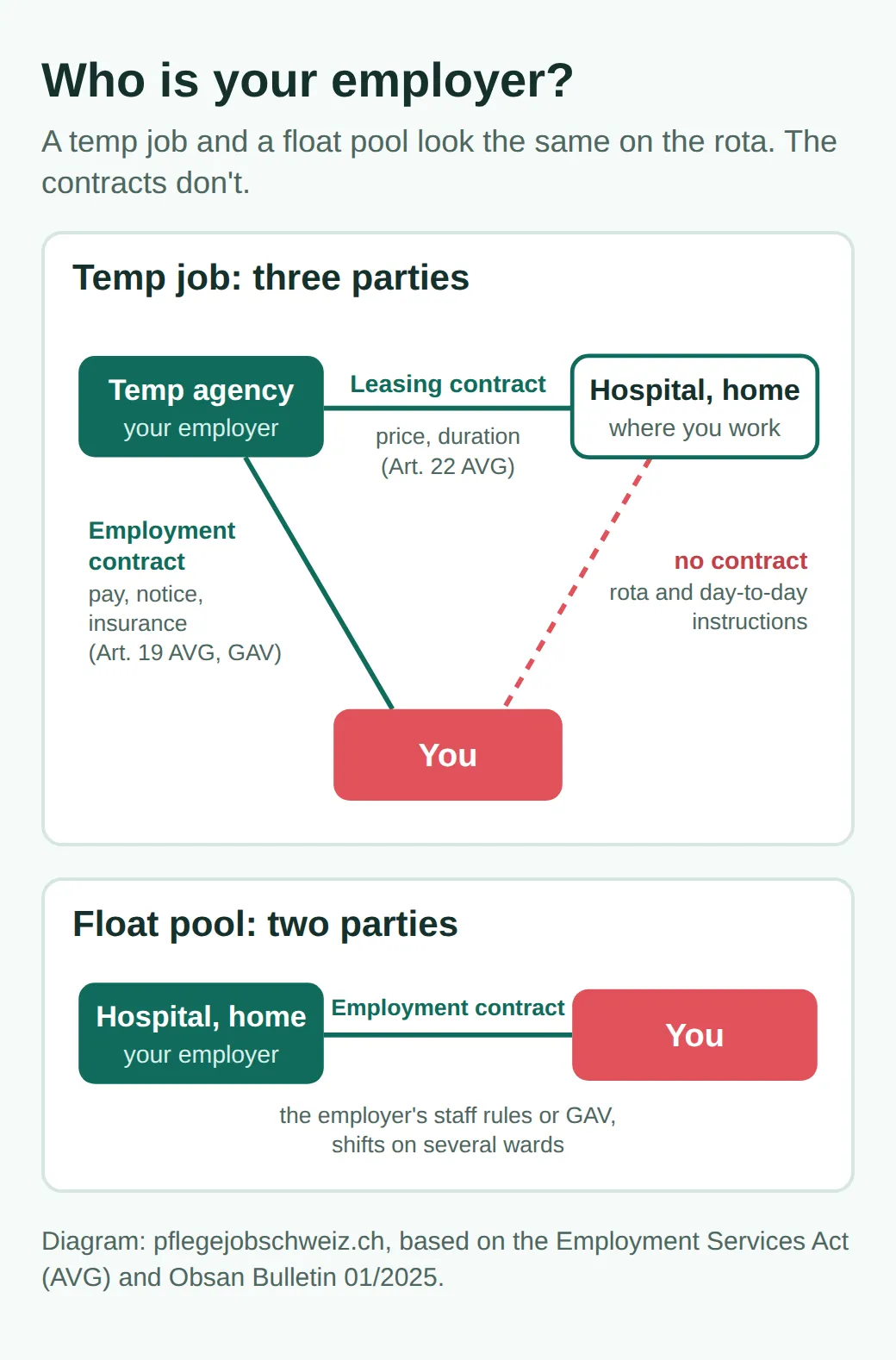
An internal nursing pool, often called a float pool (Springerpool), is simpler. The hospital or care home employs you directly and sends you to different wards or sites as needed. Many nurses mix the two. Florian Liberatore of the Zurich University of Applied Sciences (ZHAW) writes in the same bulletin that more and more people in nursing hold several jobs at once: say a permanent part-time post, some hours in the pool and shifts as a floater for a temp agency. For the temp job, the first question is which agreement sets your pay.
Which collective agreement covers your temp job?
Always the collective employment agreement for staff leasing (GAV Personalverleih), but not always with its own pay tables. Since 2012 it has applied across Switzerland to every firm licensed to hire out staff whose main business is doing so (GAV Personalverleih, Art. 2, in German). Which pay and working-time rules it gives you depends, under Article 3, on the business where you work.
If the business you're placed with has a collective agreement that has been declared generally binding, its pay and working-time rules apply to you as well. Article 20 of the Employment Services Act requires this. In nursing that hardly ever happens: the State Secretariat for Economic Affairs (SECO) keeps a list (in German) of the agreements the Federal Council has declared generally binding, and as of 1 October 2026 it names none for hospitals, care homes or Spitex.
Annex 1 of the staff leasing agreement matters more. It lists sector agreements that are not generally binding but whose pay and working-time rules take precedence anyway. For healthcare these are the Aargau cantonal hospitals, Zug Cantonal Hospital, Bern's hospitals and clinics, Bern's long-term care sector, the Hôpital du Jura, care homes and private hospitals in Ticino, and three agreements in French-speaking Switzerland, among them the CCT SAN for the health sector in Vaud. If you temp in one of these, the hospital agreement's tables apply to your pay and working hours. Sick pay and the pension fund still follow the staff leasing agreement.
In every other business the staff leasing agreement applies in full. That includes hospitals with their own staff regulations, such as the cantonal hospitals in Zurich, and care homes without a collective agreement. The minimum wage calculator in the tempdata database shows which table applies in your case. The social partners link to it from their page for temporary workers (in German). The minimum wages themselves are set out in the agreement.
How much do temporary nurses earn?
At least the wage in Article 20 of the staff leasing agreement, which depends on your training and where you work. You count as skilled if you hold a Federal VET Diploma (EFZ) in the field, a healthcare assistant (Fachfrau Gesundheit) for example, or at least three years of relevant vocational training. You count as semi-skilled with at least four years of work experience of at least 1,000 hours a year. The agreement has no separate, higher level for registered nurses with an HF diploma or an FH degree. The highest minimum wage level is the one for skilled workers.
| 2026, base pay per hour | Standard | High-wage area | Ticino |
|---|---|---|---|
| Skilled | CHF 25.86 | CHF 27.62 | CHF 24.03 |
| Semi-skilled | CHF 22.76 | CHF 24.30 | CHF 21.15 |
| Unskilled | CHF 21.22 | CHF 22.39 | CHF 18.92 |
The high-wage areas are the Bern agglomeration, the Arc lémanique and the cantons of Basel-Stadt, Basel-Landschaft, Zurich and Geneva. Unskilled workers in Geneva have their own rate of CHF 22.70. What counts is where the client business is, not where the agency has its office (Art. 22). In the first year after an apprenticeship, the agency may cut the skilled rate by 10 percent. The rates are adjusted for inflation every year on 1 January.
These figures are a floor, and for a registered nurse they say little, because the agreement has no level for you. What an HF nurse earns in a permanent job is in our article on HF nurse salaries. Obsan writes that temps in nursing earn more. Nobody in Switzerland systematically tracks how much more. For night and Sunday supplements, hospitals and care homes also apply their own rules to agency staff (Art. 24 of the agreement). So the most useful tool is a comparison you work out yourself.
Hourly or monthly pay: how to compare
Divide the agency's hourly rate by 1.211, multiply the result by 2,187 hours and divide by 12. That gives you the monthly salary paid 13 times a year. The calculation is ours, but the figures come from the agreement: it assumes 2,187 hours a year, 52.07 weeks of 42 hours (Art. 20 para. 7), and builds the hourly wage out of four parts in Annex 2.
The first part is the base wage. On top come 3.2 percent for public holidays, 8.33 percent for four weeks' holiday and another 8.33 percent for the 13th-month salary. So the claim you keep reading, that temps don't get a 13th salary, is wrong: Article 18 gives you an explicit right to it. It's just built into the hourly rate. Together the three supplements make the factor 1.211.
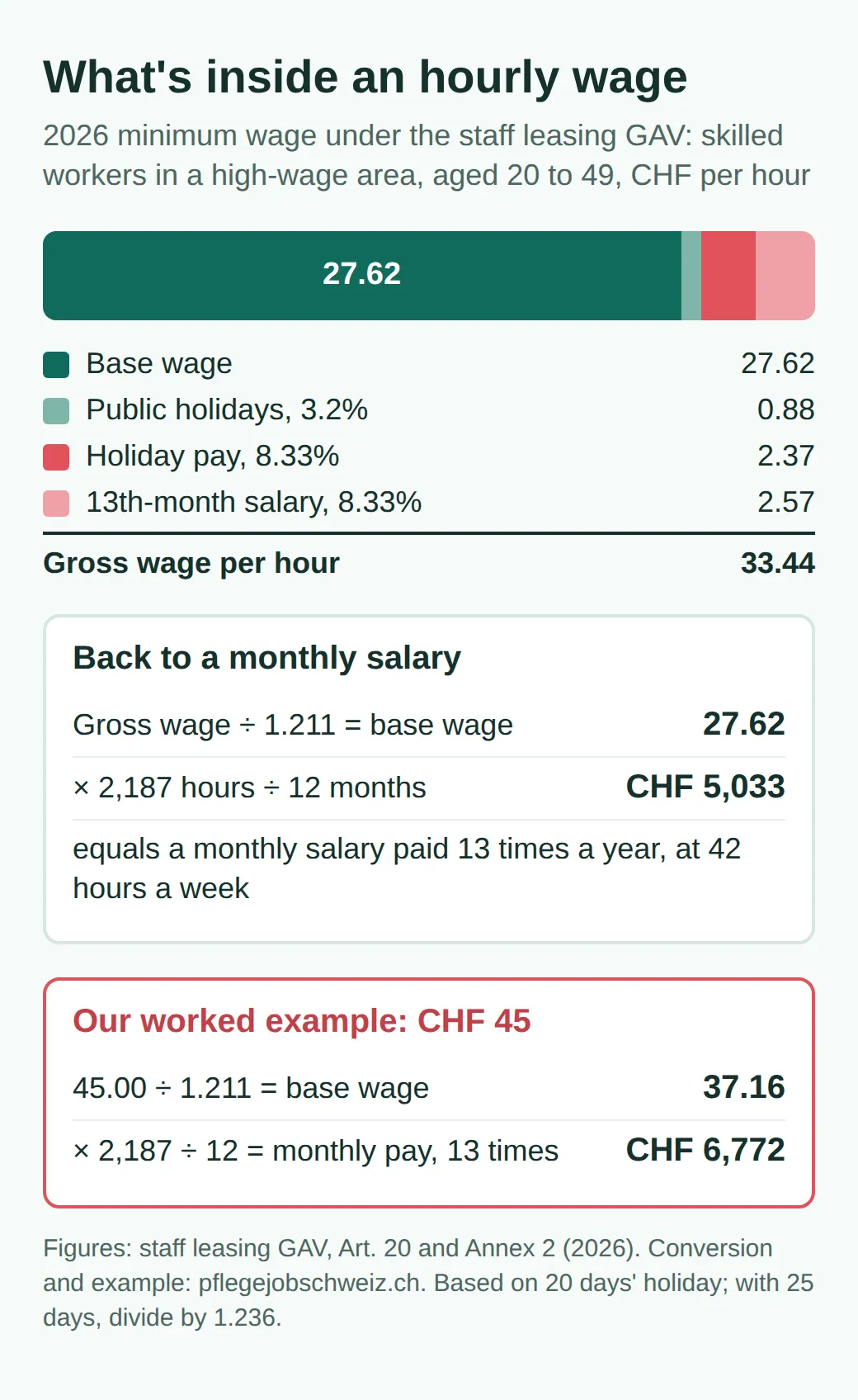
An example: an agency offers you CHF 45 an hour, holidays, public holidays and 13th-month salary included. Divided by 1.211 that's CHF 37.16 base pay, which matches a permanent job paying CHF 6,772 a month, 13 times a year, at 42 hours a week. As a rule of thumb, the hourly rate times 150 will do.
You'll need to adjust for two things. If your permanent job has a 40-hour week, multiply the result by 40 and divide by 42. And if you get five weeks' holiday because you're under 20 or 50 or over, the hourly rate includes a holiday share of 10.6 percent; then divide by 1.236. If the offer gives only a base wage without these supplements, that figure goes straight into the calculation as the base wage. What the pay doesn't show is in the next part of the contract.
Sick pay, pension fund, training
This is where you find the differences the hourly rate hides. Obsan notes that sick pay can be lower for temps. The agreement shows when. If you fall ill, sick pay insurance gives you 80 percent of your wage after no more than two waiting days, which are unpaid (Art. 28 and 29 of the agreement). You share the premium with the agency: your share is at most half, and at most 3.5 percent of your wage.
How long sick pay lasts depends on the pension fund. If the agreement requires you to join the pension fund, or a generally binding agreement applies where you're placed, you get up to 720 days of benefits within 900 days. Otherwise it's only 60 days within 360. Under Article 31 you're a member from day one if you have children to support or a contract with no end date or for more than three months. For shorter assignments, membership starts from the 14th working week at the latest.
So a nurse without children who takes a two-month assignment isn't in the pension fund at first, and in a longer illness would only get 60 days of sick pay. Staying with the same agency helps: assignments within twelve months are added together (Art. 5), and 22 paid days count as one month. You're insured with Suva against work accidents from the first agreed working day.
One benefit hardly ever appears in an assignment contract: the temptraining further education fund. According to the joint committee that runs the agreement, after 88 hours of temporary work you can apply for up to CHF 5,000, depending on the hours you've worked. It's paid for out of the 0.4 percent GAV contribution that you and your employer each pay (Art. 7). Which leaves the question of how secure the assignments themselves are.
How predictable is temp work?
You have more say over when you work, but an assignment can also end at short notice. During the probation period, which is the first three months on an open-ended contract, the notice period is two working days. After that it's seven days up to the sixth month and one month from the seventh month on (Art. 11 of the agreement). The law explicitly allows notice periods this short in the first six months (Art. 19 para. 4 AVG). On a fixed-term assignment, the first two thirds count as probation, three months at most.
That freedom has a cost for the team. Obsan writes that team and company culture can suffer when temps change often. In February 2025, SRF (in German) reported resentment in some hospitals because temps could pick their own shifts and the work was shared out unevenly. For many nurses, though, that choice is exactly why they temp: Obsan lists more freedom over working hours and workload, higher pay and variety between workplaces.
If you want to stay on permanently after an assignment, nobody can stop you. Any agreement that makes it harder for you to move to the hospital is void, and so is any fee the agency charges you (Art. 19 para. 5 AVG). Only the hospital can owe the agency compensation, if your assignment lasted less than three months and you move within three months of it ending (Art. 22 AVG). If you want flexibility without an agency, you'll now often find it at the hospital itself.
The float pool: flexibility with your own hospital
In a pool, the hospital employs you and you step in wherever someone is missing. According to Obsan, some healthcare institutions set up such pools precisely because of the downsides of temp work. Size is what matters: if the pool is too big, nurses leave because they get too few shifts; if it's too small, the hospital has to fall back on outside staff after all.
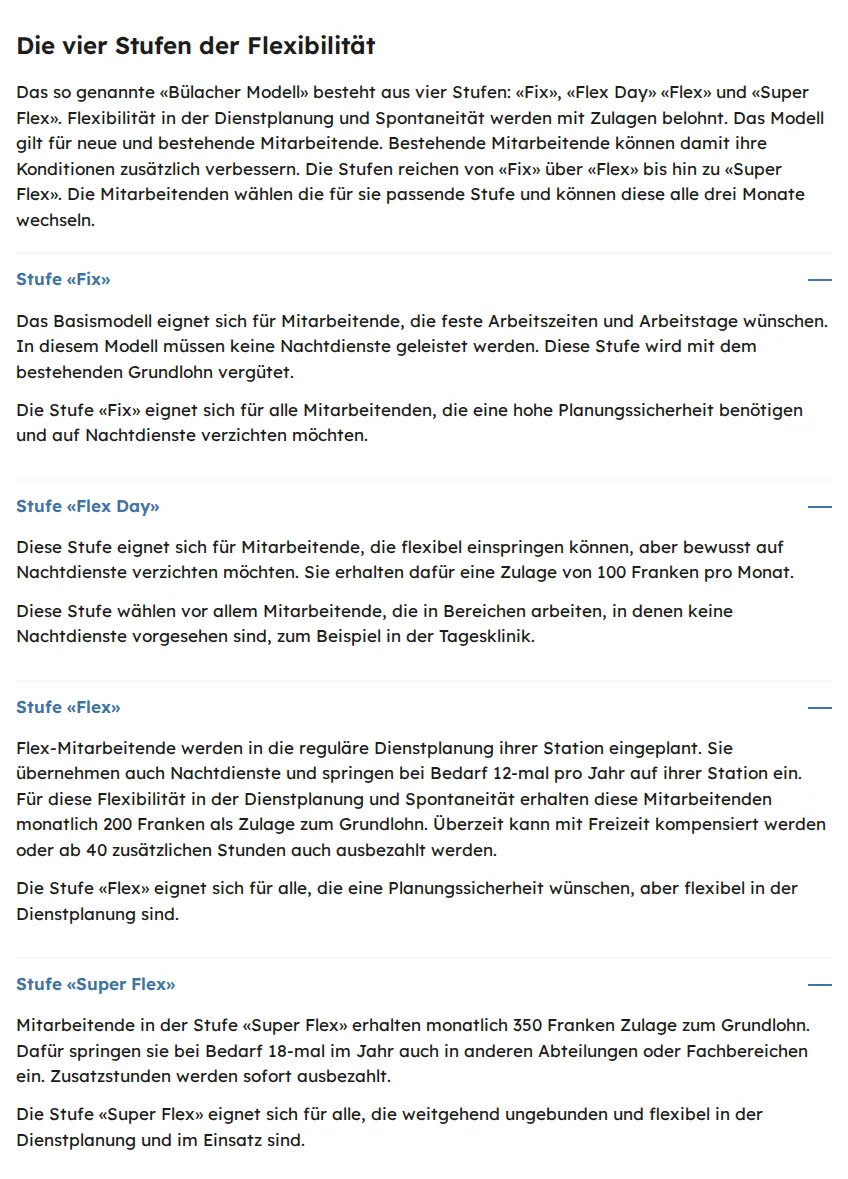
The Bülach model (in German) shows how one hospital pays for flexibility. Bülach Hospital introduced it in April 2023, with three levels at the time; today there are four. On the "Fix" level you work set hours without night shifts at the normal base salary. "Flex Day" brings an allowance of CHF 100 a month for stepping in flexibly without night shifts. On "Flex" you work night shifts and step in on your own ward twelve times a year when needed, for CHF 200 a month. "Super Flex" pays CHF 350 a month; in return you step in 18 times a year when needed, on other wards too, and extra hours are paid out straight away. You can switch level every three months.
In its launch press release (in German), the hospital wrote that gaps were often bridged with expensive outside temp staff, and that under the new model most of that money would go to its own staff instead. According to SRF, the number of temp assignments in Bülach fell from 185 to 30. To compare with agency work: CHF 350 a month comes to CHF 4,200 a year if the allowance is paid twelve times, and on top you get holidays, the pension fund and sick pay on the hospital's terms. With any pool, ask whether you'll be on a monthly salary or paid by the hour, and how holidays, the pension fund and sick pay work in that case. How far hospitals can go in giving up temps became clear in the canton of Zurich.
Zurich: where things stand after hospitals dropped temps
There's no ban; each hospital decides for itself. On 27 February 2025 the Zurich hospitals association (Verband Zürcher Krankenhäuser, VZK) announced that its members, meaning hospitals, nursing homes, rehab clinics and psychiatric hospitals, would stop using temporary nursing staff from summer 2025. According to the cantonal government's answer (in German) of 21 May 2025, the reasons they gave were team dynamics, extra work, higher costs and the nursing initiative, since agencies don't train nurses. What the initiative asks of employers is covered in our article on the nursing initiative in 2026.
The government made clear that the association can only make recommendations to its members. Each institution decides for itself, and the Health Directorate expects hospitals to keep needing temps in certain cases. At the same time it holds hospitals responsible for offering attractive jobs with flexible hours and internal pools. Not even the government knows how many temps work in Zurich hospitals.
The staffing industry association swissstaffing reported the VZK to the Competition Commission (COMCO) on 10 April 2025. According to a swissstaffing press release (in German) from September 2025, COMCO has closed its market monitoring without opening proceedings, because it's first drawing up rules for the labour market as a whole. In a letter to the association and all its member hospitals, however, it stated that their conduct had been "potentially in breach of competition law" (im potenziellen Widerspruch zum Kartellrecht). The VZK withdrew its announcement at the end of June, the release says, and declared there had never been a joint decision. Some hospitals had cut back even before the association's announcement: according to SRF, University Hospital Zurich says it reduced temp work in 2024 from 60 to 10 full-time equivalents. Either way, take a close look at an offer before you accept an assignment.
Before you sign
Check the agency first. Anyone who hires out staff on a commercial basis needs a licence from the canton (Art. 12 AVG). Without one, your employment contract is invalid. SECO and the cantons keep a public register (in German) of licensed recruitment and staffing firms, more than 7,400 in October 2026 according to SECO.
Then the assignment contract. It must state your pay category, meaning whether you count as skilled, semi-skilled or unskilled (Art. 19 of the agreement). Ask which collective agreement applies where you'll work, whether the hourly rate already includes holidays, public holidays and the 13th-month salary, and when you'll join the pension fund. A short message to your consultant is enough:
Hello, before I confirm the assignment, could you give me three details? Does a GAV from Annex 1 apply at the client business, or the GAV Personalverleih? Does the hourly rate of CHF [amount] include holidays, public holidays and the 13th-month salary? Am I in the pension fund from day one, and which sick pay cover applies? Kind regards, [Name]
Then convert the offer with the formula and set it next to a permanent job or a pool at the same hospital. A temp rate that, once converted, comes out only just above the permanent salary won't make up for the unpaid waiting days when you're ill or the short notice periods. If it's clearly higher and the assignments fit your life, temping is a good way to stay in nursing. You'll find current openings among our temporary nursing jobs.
Common questions
- Do temp workers in Switzerland get holiday pay with their wages?
- Only for a one-off assignment of three months at most, and then it must be shown separately on your payslip. Otherwise the agency pays your holiday pay when you take the time off, or at the end of your employment if you can no longer take it. Your remaining holiday entitlement has to appear on every payslip.
- Do temporary workers get paid for public holidays in Switzerland?
- Yes. After 13 weeks you're entitled to pay for official public holidays that fall on a working day. The agency may instead cover them with a supplement of 3.2 percent on your base wage. It always pays for 1 August, Swiss National Day, from your first working day.
- What is the 0.4 percent GAV deduction on my temp payslip?
- It funds the social partners' wage checks, a fund for sick pay insurance and further training. Your employer pays another 0.4 percent on top. After 88 hours of temporary work you can apply to temptraining for money towards a course, up to CHF 5,000.
- Can I do agency nursing shifts alongside a permanent job?
- The collective agreement for staff leasing doesn't forbid it, and according to Obsan more and more nurses combine a part-time post with shifts in a pool or for a temp agency. Whether you have to report a second job or get it approved is set out in your employment contract or your employer's staff regulations. Read them before you say yes.
- Can foreign nurses work through a temp agency in Switzerland?
- Yes, as long as you're allowed to work in Switzerland and to change jobs. The Employment Services Act lets agencies hire only such people. If you hold a foreign nursing diploma, the same rules for recognition by the Swiss Red Cross apply as for a permanent post.
More posts
All posts
Pflegehelfer SRK 2026: Red Cross course cost, pay vs AGS
Swiss Red Cross nursing assistant course (Pflegehelfer SRK): cost in six cantons, what you may do, pay in Zurich, Bern and Lucerne, vs AGS and FaGe.

Mandatory flu vaccine for nurses in Switzerland? 2026 rules
Can a hospital, care home or Spitex require the flu vaccine, order masks or ask if you're vaccinated? The rules, who pays and the 2026 vaccination weeks.

Return to Nursing in Switzerland 2026: Courses and Funding
Returning to nursing in Switzerland: which cantons pay for the refresher course, how to check GesReg and NAREG, and what onboarding to expect.