Nurse salary in Switzerland 2026: the official HF pay tables

The short answer
A nurse with an HF diploma starts at around CHF 70,000 to 77,000 a year in 2026 with the public employers whose pay tables we read. That is for a 100 percent post and includes the 13th salary, so roughly CHF 5,400 to 5,950 a month. After many years of service, CHF 112,000 to 117,000 is possible. Lucerne pays less, from CHF 62,850 to 94,102.
HF stands for höhere Fachschule, a college of higher vocational education, and job ads call the role Pflegefachfrau HF or Pflegefachmann HF. Our figures don't come from a survey but from the pay tables themselves: those of the Canton of Zurich, whose staff law also applies in its cantonal hospitals, the Canton of Bern, the collective employment agreement (GAV) for Bern's hospitals and clinics, the Canton of Lucerne and the Canton of Fribourg, whose hospital pays under the same law as the state. Search online for a nurse's salary and you mostly find averages with no canton, no date and no salary class. We show you instead which class your diploma sits in, where in that class you start and how fast you move up from there.
Pay ranges in four cantons
The range is wide in every table because it covers a whole career. The lowest figure is the salary with no experience, the highest the salary after twenty or more years in the same role. In between are steps, and the step you start on can make a difference of several thousand francs a year.
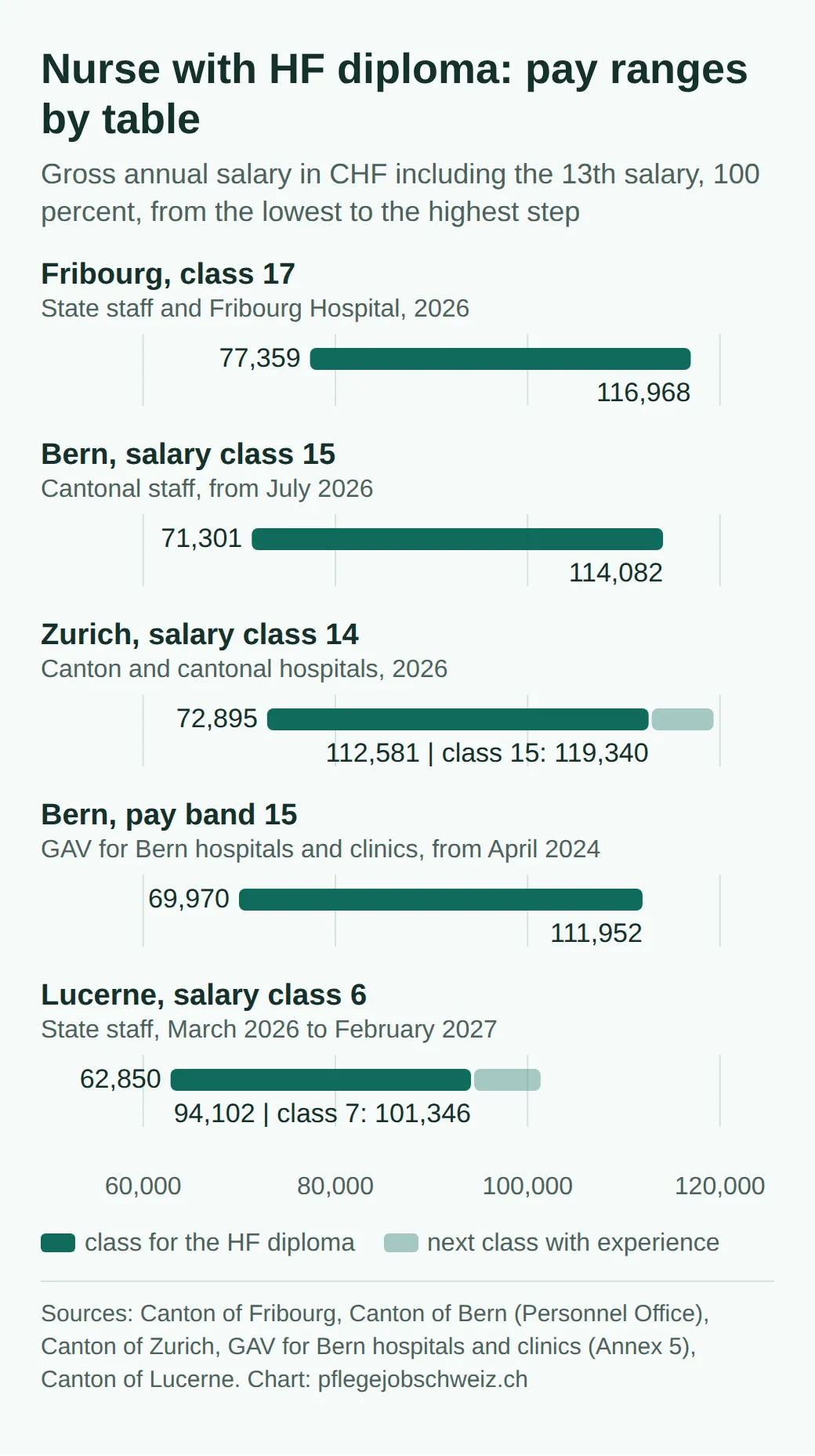
All five tables give annual salaries that already include the 13th salary. Divide by 13 to get the monthly pay. The Canton of Bern, Lucerne and Fribourg base theirs on a 42-hour week. The gaps between cantons are bigger than the averages online would suggest:
| Table | Starting pay per year | Maximum per year | Valid |
|---|---|---|---|
| Fribourg, class 17 | CHF 77,359 | CHF 116,968 | 2026 |
| Bern, salary class 15 | CHF 71,301 | CHF 114,082 | from July 2026 |
| Zurich, salary class 14 | CHF 72,895 | CHF 112,581 | 2026 |
| Bern, hospital GAV, pay band 15 | CHF 69,970 | CHF 111,952 | from April 2024 |
| Lucerne, salary class 6 | CHF 62,850 | CHF 94,102 | March 2026 to February 2027 |
At the start, Lucerne and Fribourg are CHF 14,509 a year apart, and at the top CHF 22,866. Salaries don't always stay that far apart, though: for several years of experience and shift responsibility, Lucerne provides class 7, which goes up to CHF 101,346. But first, the question of which class applies to your diploma.
Which salary class is the HF diploma in?
Each of these tables sorts jobs into classes, and the class sets the range. That grading is laid down in a separate document, not in the pay table. For Zurich it is the Human Resources Office's handbook on simplified job analysis (Handbuch Vereinfachte Funktionsanalyse), which puts nurses with an HF diploma in classes 14 and 15.
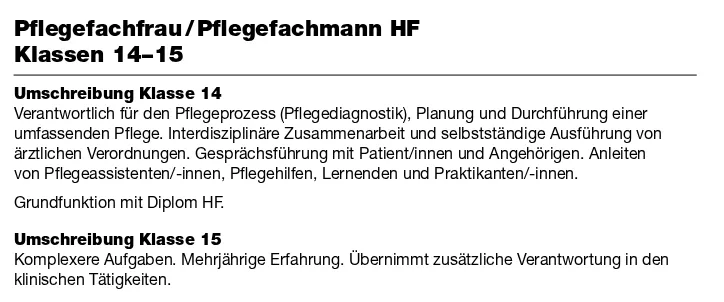
The other cantons number their classes differently, so you can't compare the numbers directly. In Bern, the annex to the Personnel Ordinance (Personalverordnung) puts registered nurses in salary class 15. The GAV for Bern's hospitals and clinics places them in pay band 15 under its benchmark job descriptions (Richtfunktionen), with the HF diploma and a bachelor's degree from a university of applied sciences (FH) treated alike. Lucerne's Pay Ordinance (Besoldungsverordnung) sets out a chain from salary class 6 with an HF diploma, through class 7 with several years of experience, to class 8 for specialist tasks such as intermediate care. Fribourg's classification of state jobs lists the role of infirmier/ière in class 17, with no distinction between HF and FH.
Further training moves you up a class. In Zurich, a nurse with an HF diploma and a postgraduate qualification in intensive, emergency or anaesthesia care is in class 16, and in class 17 with extra duties such as responsibility for equipment. How the HF and FH qualifications differ otherwise is a topic of its own. What matters here is what the class means in francs, canton by canton.
The tables canton by canton
Zurich: salary class 14 in the cantonal hospitals
Zurich's 2026 pay table for salary class 14 starts at entry step 2 (Anlaufstufe 2) with CHF 72,895 a year, which is CHF 5,607.30 a month. The first regular step is CHF 78,250, and the top one, step 29, is CHF 112,581, or 8,660.10 a month. In class 15, the table ends at CHF 119,340.
It matters who this applies to. In a 2022 report to the cantonal parliament, the cantonal government stated that only nurses covered by cantonal staff law are paid under these rules. According to the same report, the staff regulations of the four cantonal hospitals were revised: they may depart from staff law to benefit nursing staff, for example with extra money for pay progression and higher allowances for night, weekend and on-call duty. The government saw no need to grade nursing higher. It relied on a comparison of hospital pay for 2020, which found Zurich's nursing salaries above the Swiss market rate.
Bern: the canton and the hospitals each have their own table
In Bern there are two tables. Cantonal staff are paid under the Personnel Office's salary class table (Gehaltsklassentabelle), in a new version since July 2026. Salary class 15 starts at a base salary of CHF 5,484.70 a month, or CHF 71,301.10 a year. Under the Personnel Ordinance, this is the starting salary if you meet the requirements of the post. After 75 steps, the maximum is CHF 8,775.55 a month. In the first half of 2026 it was still CHF 8,638.40, while the starting salary stayed the same. Nurses employed by the canton work in places such as the prison system, which the Personnel Ordinance names specifically in its rules on night work.
Hospitals and clinics that have signed up to this GAV use its own table instead. Its pay table in Annex 5, valid from April 2024, sets pay band 15 at CHF 69,970.05 to 111,952.45 a year. We found no newer version, so ask the hospital for the table currently in force. Pay may only be lower in one case: if you don't yet meet all the requirements of the role, you can start up to 3 percent below the minimum. Under the benchmark job descriptions, there's no entitlement to the maximum.
Lucerne: a lower class and its own curve
Lucerne has the lowest range in this overview. Under its 2026 pay guidelines (Besoldungsgrundlagen), valid from 1 March 2026 to the end of February 2027, salary class 6 runs from CHF 62,850 to 94,102 and class 7 from CHF 67,688 to 101,346. The table rose by 0.2 percent compared with 2025. It applies to state staff and the canton's public-law institutions. Your employment contract tells you whether your employer is one of them.
In Lucerne, the minimum isn't the usual starting salary. The ordinance sets a trend curve (Tendenzkurve) for each class, showing pay for good performance. It starts at 111 percent of the minimum and ends after 15 experience steps at 90 percent of the maximum. For class 6, that means CHF 69,763.50 with no experience and CHF 84,691.80 after 15 years. The curve doesn't give you a right to these figures, though.
Fribourg: the highest start, fixed steps
Fribourg pays the most in this overview. The state's 2026 salary scale starts class 17 at CHF 5,950.70 a month, or 77,359.10 a year, and ends after 20 steps at CHF 8,997.55 a month, or 116,968.15 a year. It also applies at Fribourg Hospital (HFR): under the hospital act, its staff are subject to the legislation on state staff. How you get beyond the first step is something each of these employers handles differently.
How your starting salary is set
Your experience decides the step you start on. Zurich says on its page on pay and benefits that pay is set at a step when you start, based on your training, work experience and skills. The canton gives no fixed formula there.
Bern is more precise. Under Article 40 of the Personnel Ordinance, the canton can credit up to four salary steps for each full year of work experience. Experience at 50 percent or more counts in full, time in training not at all. Under Article 33, the first twelve steps each add 1.5 percent to your pay, and after that the steps get smaller.
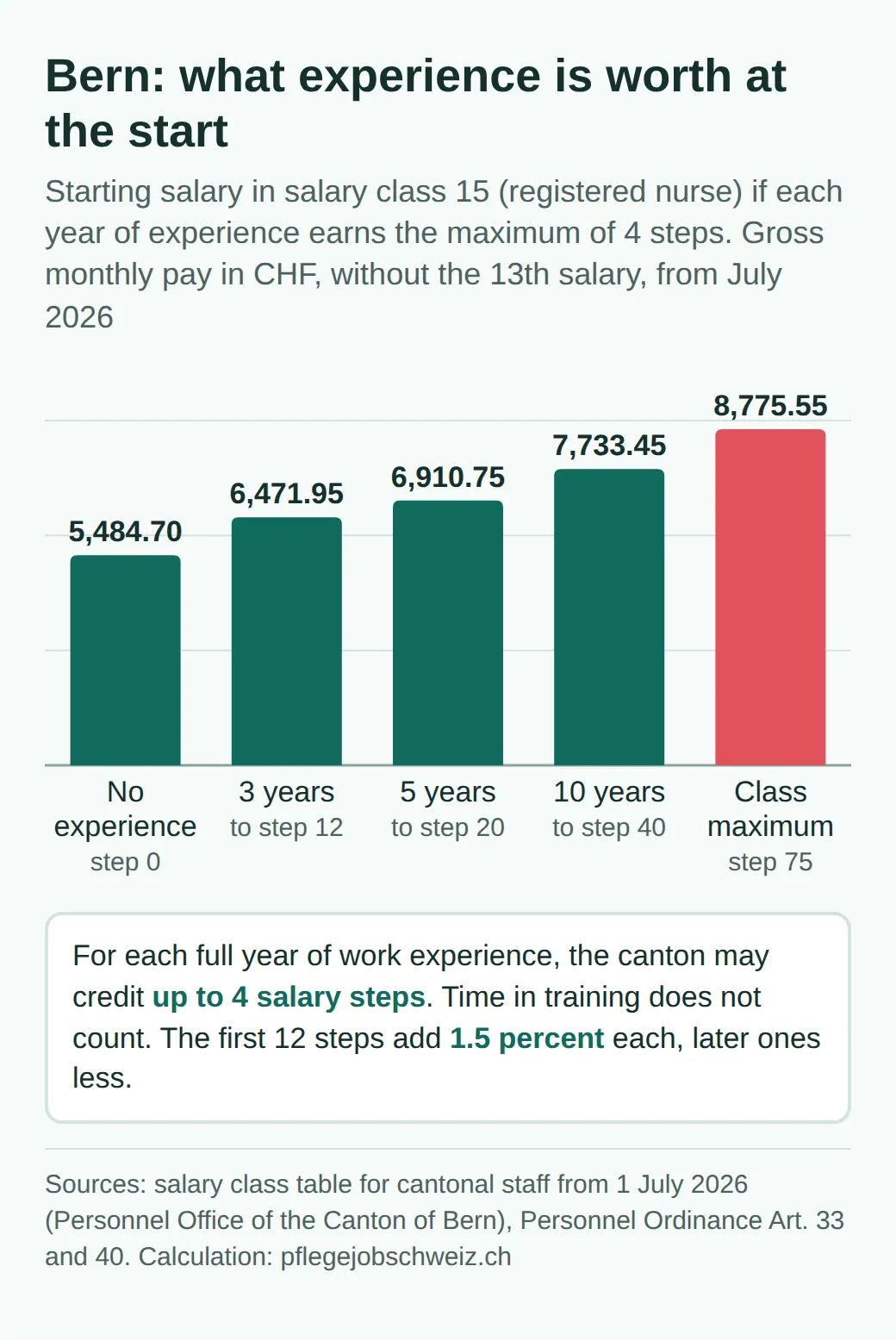
If you change jobs with three years' experience and all twelve steps are credited, you start at CHF 6,471.95 instead of 5,484.70 a month. That's almost CHF 1,000 more, or about CHF 12,800 a year with the 13th salary. With ten years it can be up to CHF 7,733.45. But the canton doesn't have to give you these steps in full: it also weighs how well your previous job matches the new one and what the labour market looks like. So before you sign, ask how many steps you're getting and why.
How fast your pay rises after that
Once you've started, the yearly steps set the pace, and here the systems differ markedly. In Fribourg you move up one step each year, which in class 17 is exactly CHF 1,980.55 more a year. That's set out in Article 103 of the staff regulations. If you exceed the requirements, you can get up to two steps. If your performance falls short, the employer can refuse or postpone the step, and if some skills are partly lacking you get half a step. After ten years without a change of class you'd be at CHF 97,163.30, and after twenty at the maximum.
In Bern, progression depends on your annual appraisal and on the money the canton sets aside for it. Good performance can earn up to four steps a year, outstanding performance up to six, and merely adequate performance none. In Lucerne the trend curve is the yardstick, and performance plays a part there too. In Zurich, the cantonal government also sets the cost-of-living allowance every year with effect from 1 January. So if you want to know what a job will be worth in five years, ask about typical pay progression rather than the maximum. On top of the base salary come amounts that no table shows.
Allowances and the 13th salary
The 13th salary is already included in every figure in this article. What comes on top is mainly allowances for night and Sunday shifts, and each employer sets its own. We list only what the rules we read actually say.
- Lucerne: CHF 8 per night hour between 8 pm and 6 am plus 10 minutes of time credit, and CHF 10 per hour on Sundays. The two can be combined (§ 18 of the Pay Ordinance).
- Fribourg: night work between 11 pm and 6 am counts as 115 percent of working time. On top come allowances for nights, Sundays and public holidays under an annex to the staff regulations.
- Bern, canton: employees up to salary class 23 receive an allowance for night and weekend work. Nursing staff in the prison system also get a 20 percent time credit for work between 8 pm and 6 am.
- Zurich: from 10 years of service there's a long-service award every five years, usually one eighteenth of the annual salary, and one twelfth after 25 years. The cantonal hospitals may pay higher allowances for irregular hours.
For a nurse who regularly works nights, these amounts quickly add up to a few thousand francs a year. But you won't find them in the salary class: they're in the staff regulations or the GAV. With private employers, on the other hand, there's often no table at all.
Private hospitals, care homes and Spitex
Private hospitals, care homes and home care services (Spitex) have no pay table that applies to all of them. The Swiss Nurses Association (SBK) writes on its page on collective agreements that GAVs should become standard in healthcare too. That's a goal, not yet the rule. Whether a GAV applies to your job is stated in your employment contract or the staff regulations.
If there isn't one, the cantonal tables are still useful. They show what a public employer in the same region pays for the same work, and so what a private offer has to compete with. To see what the nursing initiative changes about working conditions, read our article on implementing the nursing initiative. If you're coming with a foreign diploma, you first need recognition by the Swiss Red Cross, because without it the Bern GAV, for example, places you one band lower.
Before you sign a contract
Convert every offer to an annual salary at 100 percent, including the 13th salary, and look at the weekly hours: in the Canton of Bern, Lucerne and Fribourg it's 42 hours. Then set the result against your canton's range. If it's close to the minimum even though you bring experience, you have good reason to ask.
With a public employer or a hospital under a GAV, you can ask for your grading in writing, for example like this:
Dear [name], thank you for the offer. To help me assess it: which salary class and step have I been placed in, and how many years of work experience have you credited? Since my diploma, I have worked [number] years at [percentage] percent or more. Kind regards, [your name]
With the class and step in hand, you can read any pay table yourself and compare offers honestly, across cantonal borders too.
Common questions
- How much do student nurses earn during HF training in Switzerland?
- The training employer decides, often following a regional recommendation. For 2025, the health sector training organisation for Central Switzerland (XUND) recommends CHF 1,500 to 1,800 a month in the first year of study, 1,600 to 1,900 in the second and 1,700 to 2,000 in the third, each paid 13 times. A collective employment agreement or cantonal guidelines take precedence over this recommendation.
- Do nurses with a bachelor's degree earn more than nurses with an HF diploma?
- That depends on the employer. The Canton of Zurich puts the bachelor's in nursing in salary class 16, the same as an HF nurse with special duties, while the basic HF role is in classes 14 to 15. Under the collective employment agreement for Bern's hospitals and clinics, the HF diploma and the bachelor's degree share pay band 15, and Fribourg's classification has only one class for both.
- Does part-time work count as full experience when my starting salary is set?
- In the Canton of Bern it does, as long as you worked at least 50 percent. The Personnel Ordinance counts work experience from that level in full. Other cantons and hospitals set their own rules, so ask how your years were counted before you sign.
- Will I get the same salary in Switzerland with a foreign nursing diploma?
- Not necessarily, as long as you don't have recognition from the Swiss Red Cross. Under the collective employment agreement for Bern's hospitals and clinics, a foreign diploma without recognition is placed in pay band 14, one band below the HF diploma. With recognition, pay band 15 applies, as for a Swiss diploma.
- How often are nursing pay tables in Switzerland updated?
- Usually once a year. Zurich sets its cost-of-living allowance with effect from 1 January, Lucerne raised its table by 0.2 percent for March 2026, and Bern renews its table every year in line with its cost-of-living adjustment. So always check the date of a table before you use it for your sums.
More posts
All posts
Pflegehelfer SRK 2026: Red Cross course cost, pay vs AGS
Swiss Red Cross nursing assistant course (Pflegehelfer SRK): cost in six cantons, what you may do, pay in Zurich, Bern and Lucerne, vs AGS and FaGe.
Return to Nursing in Switzerland 2026: Courses and Funding
Returning to nursing in Switzerland: which cantons pay for the refresher course, how to check GesReg and NAREG, and what onboarding to expect.
Night shift and on-call pay for nurses in Switzerland (2026)
Night shift pay for nurses in Switzerland: 10% extra time off by law, 25% more for occasional nights, and the hourly allowances in Aargau, Solothurn and Zug.