Pflegehelfer SRK 2026: Red Cross course cost, pay vs AGS

The short answer
The Swiss Red Cross nursing assistant course (Lehrgang Pflegehelfende SRK) consists of 120 lessons and 12 to 15 days of practical work. At six cantonal Red Cross branches it costs between CHF 1,920 and 2,920. Afterwards you provide care in stable situations, always on the instructions of a qualified professional. A federal qualification only comes with the two-year apprenticeship as a health and social care assistant (AGS EBA).
Search for "Pflegehelfer SRK" and you'll mostly find two kinds of page: one cantonal branch's course and salary sites quoting figures without a source. We put the course pages of six cantonal branches side by side and read the Swiss Red Cross skills profile, the AGS training ordinance, the Spitex contract with the health insurers and three public pay tables. That shows you what the course costs, what you may do afterwards, what you'll earn and when an apprenticeship is the better deal.
What the course covers
The course is short and built the same way everywhere. Every cantonal branch teaches to a national framework curriculum, and the "Pflegehelfende SRK" certificate is valid throughout Switzerland. At the Zurich branch (in German) the teaching is split into two modules of 60 lessons each. The first covers your role as a nursing assistant, personal hygiene, mobility, elimination, breathing and circulation. The second deals with eating and drinking, sleep, preventive care, falls, pain and emergencies, housekeeping and care documentation. Each module ends with a test. Bern, Aargau, St. Gallen and Lucerne speak of 120 hours of theory rather than lessons.
After the classes comes a work placement in a care home, with Spitex home care or at another institution. In Zurich, Bern, Basel and Lucerne it lasts 15 days, in Aargau at least 12 and in St. Gallen 12 to 15. As a rule you find the placement yourself, and the cantonal branches hand out lists of possible placement providers. In Zurich you must finish everything within twelve months and attend at least 90 percent of the classes. On top of that there's study at home: the Red Cross in Basel (in German) puts it at around 60 hours. The Zurich training centre says it has helped around 10,000 nursing assistants earn the certificate over the last 15 years.
To be admitted, all six branches require you to be at least 18 and to speak good German, but they differ on the level. Bern, Aargau and Basel ask for B1, St. Gallen for B1 written and B2 spoken, Lucerne for a B2 certificate or a language test, and Zurich recommends B2 and an understanding of Swiss German dialect. Almost everywhere you first attend an information session or an interview; in Zurich a digital info tour is recommended. Bern and Lucerne require people without a Swiss passport to hold a valid residence and work permit. If you have a nursing diploma from abroad, your route is the recognition procedure instead, which we explain in our article on recognition of foreign nursing diplomas. For everyone else, the first question is the price, and that depends more on the canton than you'd expect for a course that's the same everywhere.
What does the Pflegehelfer SRK course cost?
Between CHF 1,920 and 2,920, depending on the cantonal branch and how the course is taught. The most expensive is the classroom-only course at the Bern branch (in German) at CHF 2,920, the cheapest the same Bern course with self-study at CHF 1,920. In between come Aargau and Basel at CHF 2,550 each, St. Gallen at 2,365, the joint training centre for Lucerne, Unterwalden and Zug at 2,350 and Zurich at CHF 2,265 (all in German).
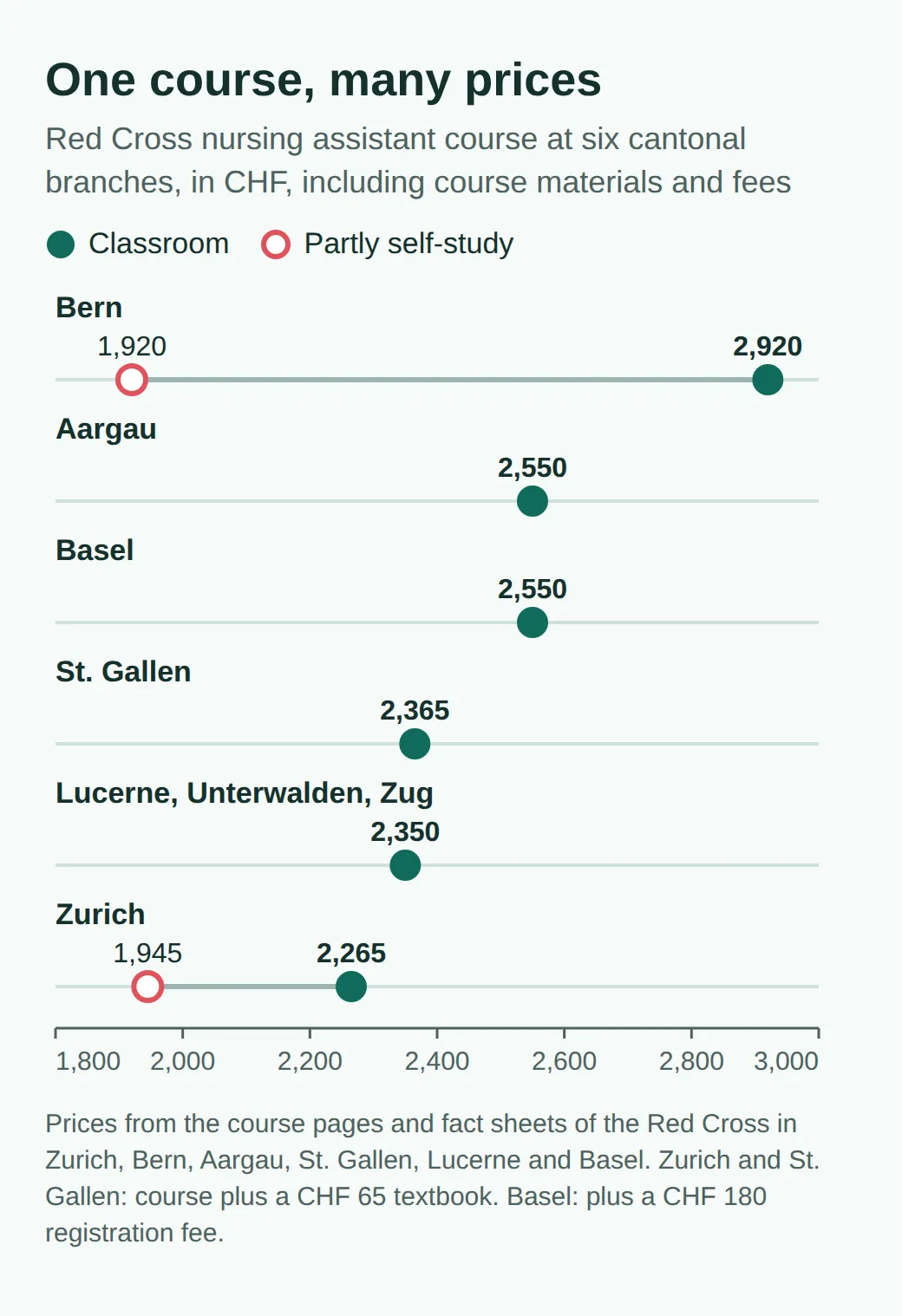
Compare the total, not the first price on the page. In Zurich each module costs CHF 1,100 and the textbook another CHF 65, and in St. Gallen the same CHF 65 comes on top of CHF 2,300. According to its fact sheet (in German), the Red Cross in Basel charges CHF 2,370 plus a CHF 180 registration fee after the admission interview. In Bern, learning support, course materials and the registration fee are included. You pay early: in Aargau no later than 14 days before the course starts, in Basel before the written exam.
The cheaper formats save classroom days, not content. In Bern's classroom and self-study format you attend eight course days, and you work through the rest at home, at around eight hours a week. For CHF 1,880 plus the textbook, Zurich offers a version with e-learning that it calls blended learning.
One item is missing from every price list. The placement is unpaid, as the Bern branch spells out, and if you're working alongside the course you'll have to take those 12 to 15 days off. If money is tight, it's worth asking: St. Gallen lets you pay in instalments, Aargau grants a Red Cross discount on request, and Bern points to an application form from the Suyana Foundation for financial support. For people on social assistance, the Bern branch also runs the SESAM programme, which combines the course with close support.
Look at who runs the course, too. The Red Cross isn't the only provider of nursing assistant courses, but the Swiss Red Cross doesn't grant equivalence for Swiss courses from other providers or for online courses. That's stated on its page on equivalence with the Pflegehelfende SRK course (in German). What you may do with the certificate is also set by the Swiss Red Cross itself.
What nursing assistants may and may not do
Nursing assistants provide care in stable situations, guided and supervised by a professional with an HF or FH diploma or a Federal VET Diploma (EFZ). That's how the Swiss Red Cross describes it in its profile of skills and abilities (in German), last approved in 2023. The key sentence: nursing assistants "always work according to the guidelines and instructions of qualified staff".
In practice that's more than the job title suggests. You help with personal hygiene and dressing, mobilise and position people, empty urine bags and carry out preventive care against pressure sores, pneumonia, thrombosis and stiff joints. On instruction you take pulse and temperature, apply ointments and hand out medication that's been prepared. You help care for the dying, pass on changes you notice, write care reports on your own and take part in handovers.
The line is drawn where someone has to make a decision or do something invasive. Preparing medication, taking blood or giving injections isn't in the profile. Those are things a healthcare assistant (FaGe) learns in her three-year apprenticeship, as her VET ordinance sets out (in German, French and Italian), and as we show in our article on the difference between FaGe, HF and FH. The clearest statement of the line, though, is in a contract hardly anyone reads: the administrative contract (in German) that Spitex Switzerland and the association of private Spitex providers have signed with the health insurers. Its Annex 4 governs who may provide which services paid for by basic health insurance.
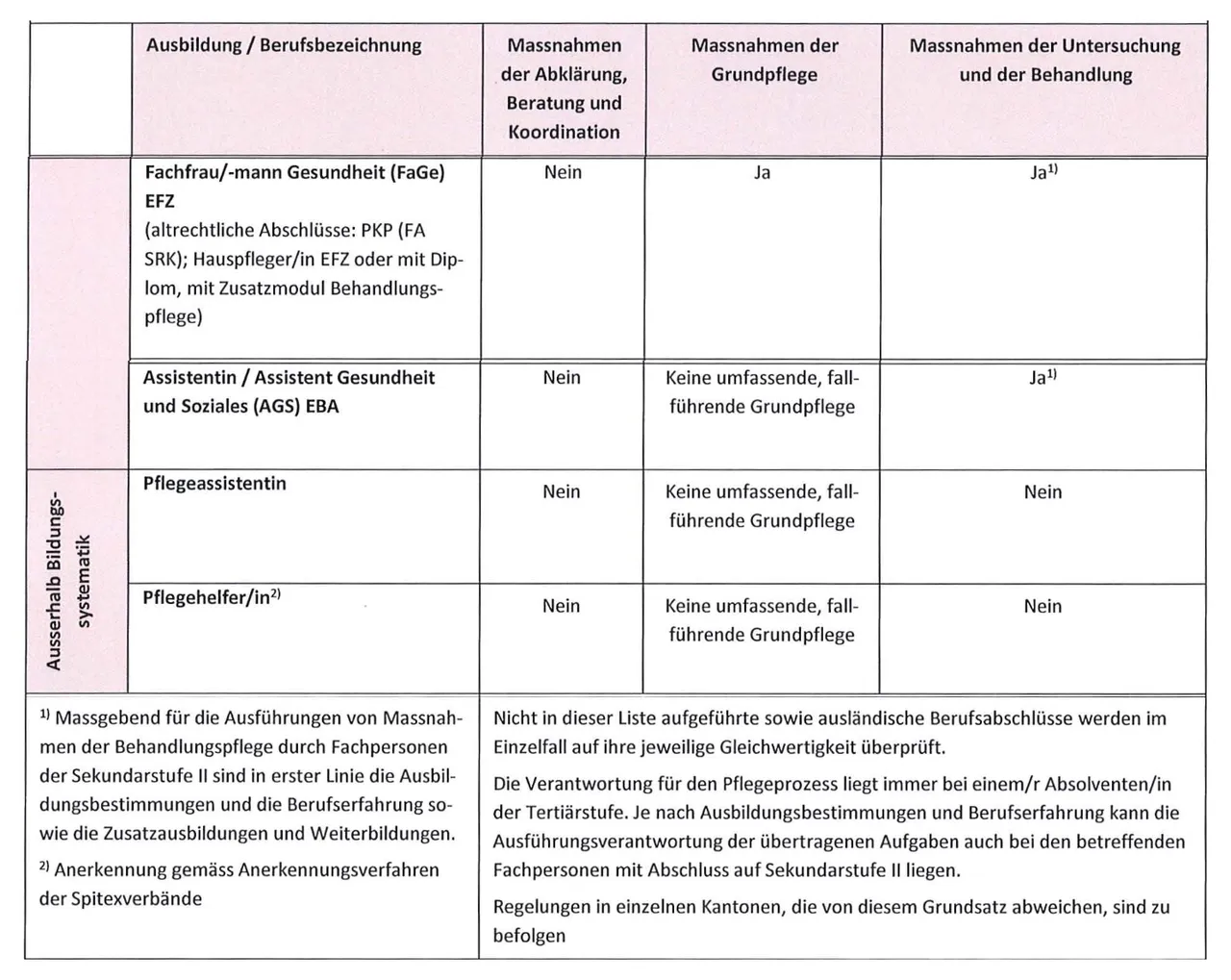
Under the contract, nursing assistants and AGS may not provide "comprehensive, case-leading basic care", meaning they can't be responsible for a case, and they may not carry out assessments or give advice. On examinations and treatment their paths split: for nursing assistants the table says no, for AGS it says yes, depending on training, experience and further training. Responsibility for the nursing process always lies with a professional with a tertiary qualification, such as a nurse with an HF or FH degree, and cantonal rules that differ take precedence. That names the most important difference from the AGS, but not the only one.
Pflegehelfer SRK or AGS EBA?
The Red Cross course is a course; the AGS is an apprenticeship that ends in a Federal VET Certificate (EBA). The AGS training ordinance (in German, French and Italian) sets it at two years. On average you work four days a week at the training company, attend 720 lessons at vocational school, 80 of them sport, and 23 to 25 days of inter-company courses. At the end come a practical assignment of three to four hours at your workplace and a two-hour written exam. The title Assistentin Gesundheit und Soziales EBA is protected by law.
| Pflegehelfer SRK | AGS EBA | |
|---|---|---|
| Type | Course with an SRK certificate | Apprenticeship with a Federal VET Certificate |
| Length | 120 lessons and 12 to 15 days of practice | 2 years |
| Cost or pay | CHF 1,920 to 2,920 | Apprentice pay, recommended in Zurich at CHF 800 and 1,000 a month |
| Treatment in home care (Spitex) | No | Yes, depending on training and experience |
The content overlaps a lot. Both help with personal hygiene, elimination, eating and mobility, help care for the dying and do housework. According to Article 4 of the ordinance, an AGS also learns to check weight, height and vital signs as a task of her own, to do simple admin and to accompany people to appointments. She works with people of all ages, in both healthcare and social care. The biggest difference, though, is time: for every lesson in the Red Cross course there are six at AGS vocational school.
For young people leaving school, the AGS is usually the better route, because it leads to a federal qualification and shortens the FaGe apprenticeship by a year. For adults the sums look different, because an apprenticeship means apprentice pay. The OdA Gesundheit Zürich recommends pay for AGS apprentices (in German) of CHF 800 a month in the first year and CHF 1,000 in the second, plus a 13th salary. Each employer sets the pay itself, though. As a nursing assistant, on the other hand, you earn a full wage from day one. The pay tables of public employers show how big the gap is after that.
How much does a Pflegehelfer SRK earn?
With the public employers whose tables we read, a nursing assistant starts on around CHF 47,300 to 51,500 a year. That's for a 100 percent post including the 13th salary, or around CHF 3,640 to 3,960 a month. In Bern and Lucerne an AGS starts CHF 2,750 to 4,380 a year higher, and a FaGe clearly higher again.
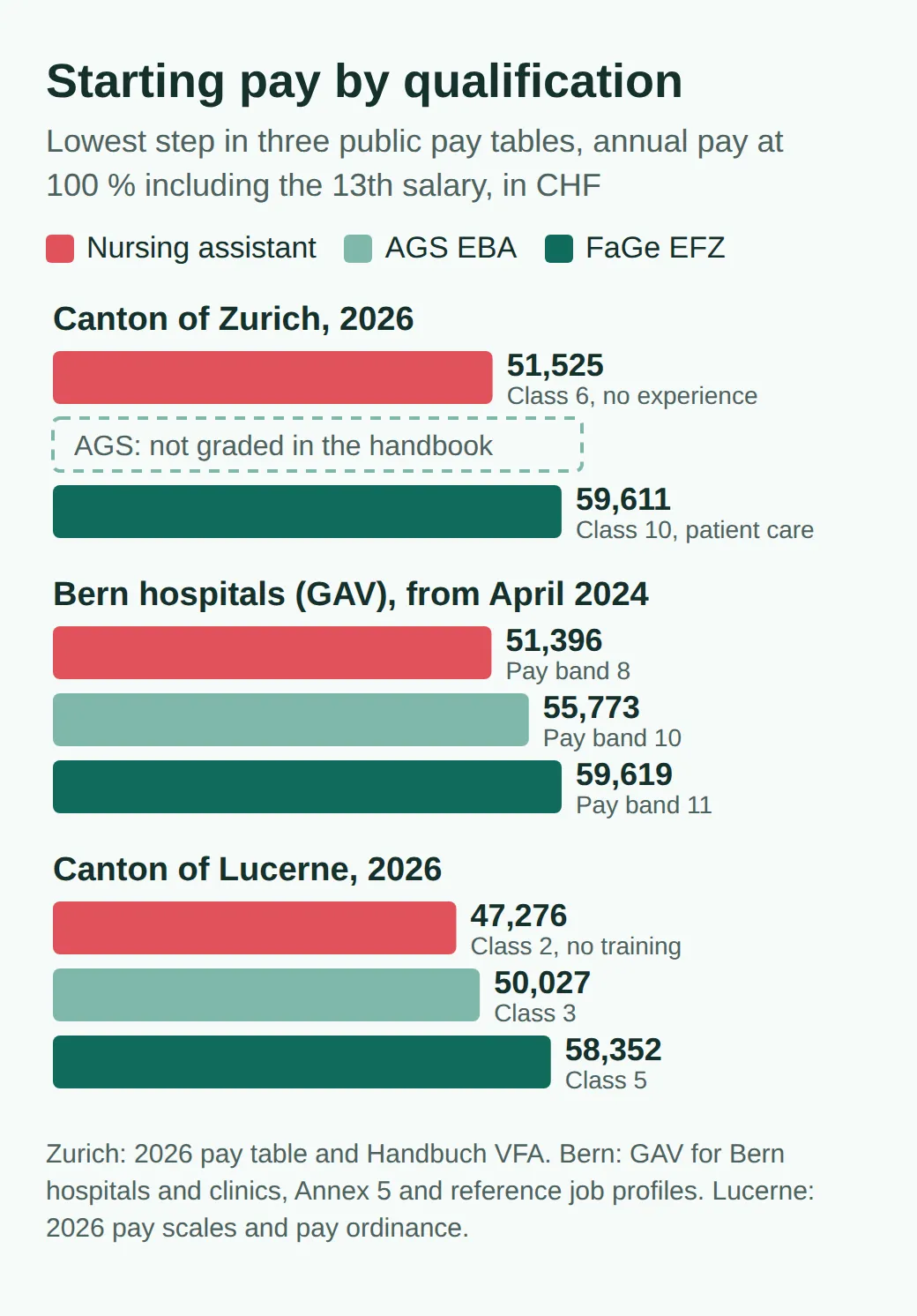
These figures come from pay tables, not surveys. Each shows the lowest step of the class a role is placed in. With experience, pay rises considerably in all three systems, and that's exactly where they differ.
Canton of Zurich: classes 6 to 9
The canton's handbook on simplified job analysis (Handbuch Vereinfachte Funktionsanalyse, in German) places nursing assistants in classes 6 to 9. What's required is "no subject-specific prior training, short on-the-job training". According to the handbook, class 6 is for people with no experience and under 20, class 7 requires one year's experience, and classes 8 and 9 several years' experience, further training and particular duties, for example in long-term care or as a group leader.
According to the 2026 pay table for class 6 (in German), pay starts at CHF 51,525 a year or CHF 3,963.45 a month. Class 7 starts at CHF 53,136, and the top step of class 9 is CHF 88,746. The FaGe sits in classes 9 and 10. Class 9, however, describes tasks in admin, logistics and housekeeping; patient care only comes in class 10, which starts at CHF 59,611. The handbook doesn't grade the AGS at all. The tables apply to people employed by the canton; whether a hospital or care home uses them is stated in your employment contract.
Bern hospitals: pay band 8 for nursing assistants
In the hospitals and clinics covered by the collective employment agreement (GAV) for Bern hospitals and clinics, the reference job profiles (Richtfunktionen, in German) divide care assistance into three pay bands. Pay band 5 covers simple tasks such as sitting with patients. Nursing assistants are in pay band 8, which requires "short specialist training in care". The profiles don't mention the Red Cross course by name, so ask the hospital whether it counts it that way. AGS are in pay band 10, FaGe in pay band 11.
The pay table in Annex 5 of the GAV, valid from April 2024, sets pay band 8 at CHF 51,395.55 to 86,626.20 a year, which is CHF 3,953.50 a month at entry. Pay band 10 runs from CHF 55,773.25 to 92,152.85. If you don't yet meet all the requirements of the role, you can start up to 3 percent below the minimum. We found no newer table.
Canton of Lucerne: class 2 or 3
In its pay ordinance (Besoldungsverordnung, in German), Lucerne sets out a separate career path for care and support assistants. Class 2 only requires an induction at the workplace. Class 3 requires an AGS qualification, a one-year training in care assistance with practice or, without training, several years of practical experience. The ordinance doesn't mention the Red Cross course. Going by its wording, then, experience decides: class 2 without it, class 3 with several years of practice. That's our reading; the employer decides the grading.
According to the 2026 pay scales (in German), class 2 runs from CHF 47,276 to 69,353 and class 3 from CHF 50,027 to 74,903, for a 42-hour week. A FaGe starts in class 5 at CHF 58,352. This table also applies to people employed by the canton; hospitals and care homes with their own pay system may differ.
For private care homes and Spitex organisations there's no table that applies to everyone, and the Swiss Red Cross expressly makes no pay recommendations. It refers you to the health department of the canton where you work. So compare any private offer with your canton's table. What you get on top for night and weekend shifts is covered in our article on night and shift allowances. One group, however, almost always works for Spitex: people caring for a family member.
Caring for a family member with the course
If a Spitex organisation employs you to care for a family member, you'll usually need the course anyway. Since a 2019 Federal Supreme Court ruling, Spitex organisations may also employ family carers who have no basic care training, writes Spitex Switzerland (in German). The contract with the health insurers (in German), however, sets a minimum requirement of a course in nursing assistance or equivalent training, to be completed within a year of being hired.
Even with the course, the scope stays narrow. Without nursing training, employed family members may only provide basic care paid for by basic health insurance, as described in Article 7 of the Health Insurance Benefits Ordinance (KLV, in German): help with personal hygiene, dressing and undressing, eating and drinking, positioning and mobilising. A nurse calls at least every two weeks and visits at least once a month. The contract applies to organisations that have signed up to it, and cantonal rules take precedence.
The Zurich branch also runs a separate course for family carers. Before you sign up, check whether the Spitex organisation accepts it as a course in nursing assistance or requires the Pflegehelfende SRK course, and whether it pays the fees. If you want to stay in care for longer, though, it's worth thinking beyond the certificate.
From certificate to vocational qualification
The Red Cross course isn't part of an apprenticeship, but it can be the start of one. For adults there are three routes to a federal qualification, and two of them don't go through the AGS.
The first is the AGS apprenticeship itself. Once you've completed it, you can shorten the FaGe apprenticeship by a year and go straight into the second year, according to the OdA Gesundheit Zürich (in German). In total, that's four years to a FaGe Federal VET Diploma.
The second skips the AGS. Zurich's vocational school ZAG (in German) admits adults with at least two years' work experience in care and support directly into the second year of the FaGe apprenticeship, after an individual assessment. Two years as a nursing assistant therefore get you to the same point as two years of AGS apprenticeship, only on a full wage instead of apprentice pay. The canton decides on the shortened apprenticeship. You negotiate pay for the shortened apprenticeship with the employer; the OdA Gesundheit Zürich makes no recommendation, but it does expect German at B2.
The third leads to the exam without an apprenticeship. If you have at least five years' work experience, you can be admitted to the qualification procedure (Art. 32 VPETO), and those years may come from another occupation. For the AGS, two of them must be at 80 percent in the field (Art. 14 of the AGS ordinance, in German), for the FaGe three years in the FaGe's field of work (Art. 16 of the FaGe ordinance, in German). So if you've already worked in another occupation, you only need the years in care on top. Whether your work as a nursing assistant counts towards them is decided by the responsible office in your canton.
Apprenticeships as AGS and FaGe
For the apprenticeship and for the shortened FaGe route, you need a training company. The shortened apprenticeship is only possible at employers licensed to train healthcare assistants. What comes after the FaGe, at a college of higher education (HF), is covered in our article on FaGe, HF and FH.
Which route suits you
If you want to get into care quickly and without an apprenticeship contract, or you're caring for a family member, the Red Cross course is the direct route. Compare the total prices of the cantonal branches near you, plan for the unpaid placement days and find out early which language certificate the branch asks for.
If you already know you want to stay in care, do the sums further ahead. In Zurich, two years' work as a nursing assistant can lead to the same shortened FaGe apprenticeship as an AGS apprenticeship, if the canton approves the shorter route, and with years from an earlier occupation one route even takes you to the exam without an apprenticeship. So at the job interview, ask which pay class you'll be in and whether the employer trains FaGe.
Common questions
- Is the work placement in the Red Cross nursing assistant course paid?
- Don't count on it. The Bern branch of the Swiss Red Cross states plainly that the 15-day placement is unpaid. You usually find the placement yourself, and the cantonal branches hand out lists of possible placement providers. If you have a job alongside the course, you'll need to take those days off.
- Can care training from abroad count instead of the SRK course?
- Possibly. On request, the Swiss Red Cross checks whether your training is equivalent to its course, provided it included at least 120 hours of theory and practical experience. This costs CHF 250, or CHF 500 if a placement is required, and you need a B1 language certificate in German, French or Italian. You get a decision within two months of a complete application at the latest.
- Do years of work as a nursing assistant count without the certificate?
- For the Swiss Red Cross equivalence check, yes, if you've worked at least five years at 60 percent in a nursing home, care home or hospital and can show further training. Experience from private care or from Spitex assignments doesn't count for this. The cantonal health department where you work can tell you whether your canton requires the certificate at all.
- Is a Pflegehelferin SRK the same as a Pflegeassistentin?
- No. The Pflegeassistentin SRK was a one-year training under the old system that is no longer offered. In 2011 the umbrella bodies OdASanté and SavoirSocial compared it with the new AGS apprenticeship. In Zurich the Pflegeassistentin still sits in pay classes 9 and 10, higher than the nursing assistant.
- Is the SRK certificate recognised in Romandy and Ticino?
- Yes. According to the cantonal branches, the Pflegehelfende SRK certificate is recognised across Switzerland. Day to day, though, what counts is the language where you work. If you want to take the course in French, the Bern branch recommends the one run by the Fribourg Red Cross.
More posts
All posts
Nurse salary in Switzerland 2026: the official HF pay tables
What an HF-qualified nurse earns in Switzerland in 2026: starting and top pay in the Zurich, Bern, Lucerne and Fribourg tables, with classes and allowances.

FaGe or registered nurse? EFZ, HF and FH in Switzerland
FaGe EFZ or nurse with an HF or FH degree: what each may do, how long training takes, what it pays in Zurich and how to get from apprenticeship to diploma.

Return to Nursing in Switzerland 2026: Courses and Funding
Returning to nursing in Switzerland: which cantons pay for the refresher course, how to check GesReg and NAREG, and what onboarding to expect.