Swiss Nursing Initiative 2026: What's in Force, What's Not

Where things stand
As of 17 October 2026, the nursing initiative is half implemented. The training campaign and direct billing of certain nursing services have applied since 1 July 2024. In April 2026 the National Council passed a watered-down version of the law on better working conditions. It's now with a committee of the Council of States. Nothing has changed yet for your working hours.
That's slow, even by the Constitution's own measure. The Constitution gave Parliament four years to turn the initiative into law, and that deadline passed on 28 November 2025. For this overview we read the reports of the Federal Office of Public Health (FOPH), the legal texts, the Federal Council's dispatch to Parliament and Parliament's voting records. Two things stand out: the training campaign is getting going more slowly than planned, and the National Council struck out or cut back much of the nursing law.
What the nursing initiative requires
On 28 November 2021, voters and cantons accepted the initiative "For strong nursing care" with 61 percent in favour. Since then, Article 117b of the Federal Constitution has required the Confederation and the cantons to promote nursing and to ensure there are enough registered nurses. The transitional provision that goes with it gives the Confederation four tasks: rules on which services nurses may bill directly, adequate payment for nursing services, working conditions that match the demands of the job, and opportunities for professional development.
In January 2022 the Federal Council decided to do this in two stages. The first stage covers training, the second working conditions. That's how the FOPH describes it on its page on implementing the nursing initiative (in German). The key dates:
- 28 November 2021: voters and cantons accept the initiative.
- 16 December 2022: Parliament passes the act promoting nursing training.
- 1 July 2024: the first stage comes into force.
- 21 May 2025: the Federal Council puts the second stage before Parliament.
- 28 April 2026: the National Council passes it with many cuts.
- 2 September 2026: the Council of States committee begins its review.
So the first stage has been in force for over two years. What it actually brings is felt mainly by students and the hospitals, care homes and home care services that train them.
What has applied since July 2024
The Federal Act on the Promotion of Training in Nursing (in German) obliges the cantons to do three things. They pay hospitals, care homes and home care (Spitex) organisations contributions towards practical training: at least half of the training costs those employers don't get reimbursed. They support the colleges of higher education (HF). And they pay training grants to nursing students at HF colleges and at universities of applied sciences (FH), so they can cover their living costs while they train. The Confederation pays up to half of what the cantons spend, for eight years, from 1 July 2024 to 30 June 2032. According to the FOPH, the Confederation and the cantons together are set to spend almost a billion francs.
What matters to you as a future nurse: how much money you get, and on what conditions, is up to each canton (Art. 7). It's your home canton that counts. Some cantons pay flat rates, graded for example by age or by whether your parents still have to support you; others look at your personal financial situation. According to the FOPH, that explains the large differences: in some cantons only 2 to 5 percent of students receive a grant, in others around 80 percent.
Nursing services without a doctor's order
The second change concerns billing health insurance. Since 1 July 2024, nurses may provide and bill certain services in assessment, advice and coordination, and in basic care, without a doctor's order. The FOPH sets this out on its page on direct billing (in German). So that costs don't rise unchecked, insurers and providers jointly monitor the volume of these services and agree on corrections. Self-employed nurses face a hurdle: if nursing costs per insured person in a canton rise faster than the Swiss average, the canton may stop issuing new authorisations (Art. 55b of the Health Insurance Act). The FOPH's first report shows how well the training campaign works in practice.
How well is the training campaign working?
More slowly than planned. In March 2026 the FOPH analysed what the cantons actually funded in the second half of 2024. Its report (in German) compares what the cantons applied for with what they billed. In every category they fell short of the plan.
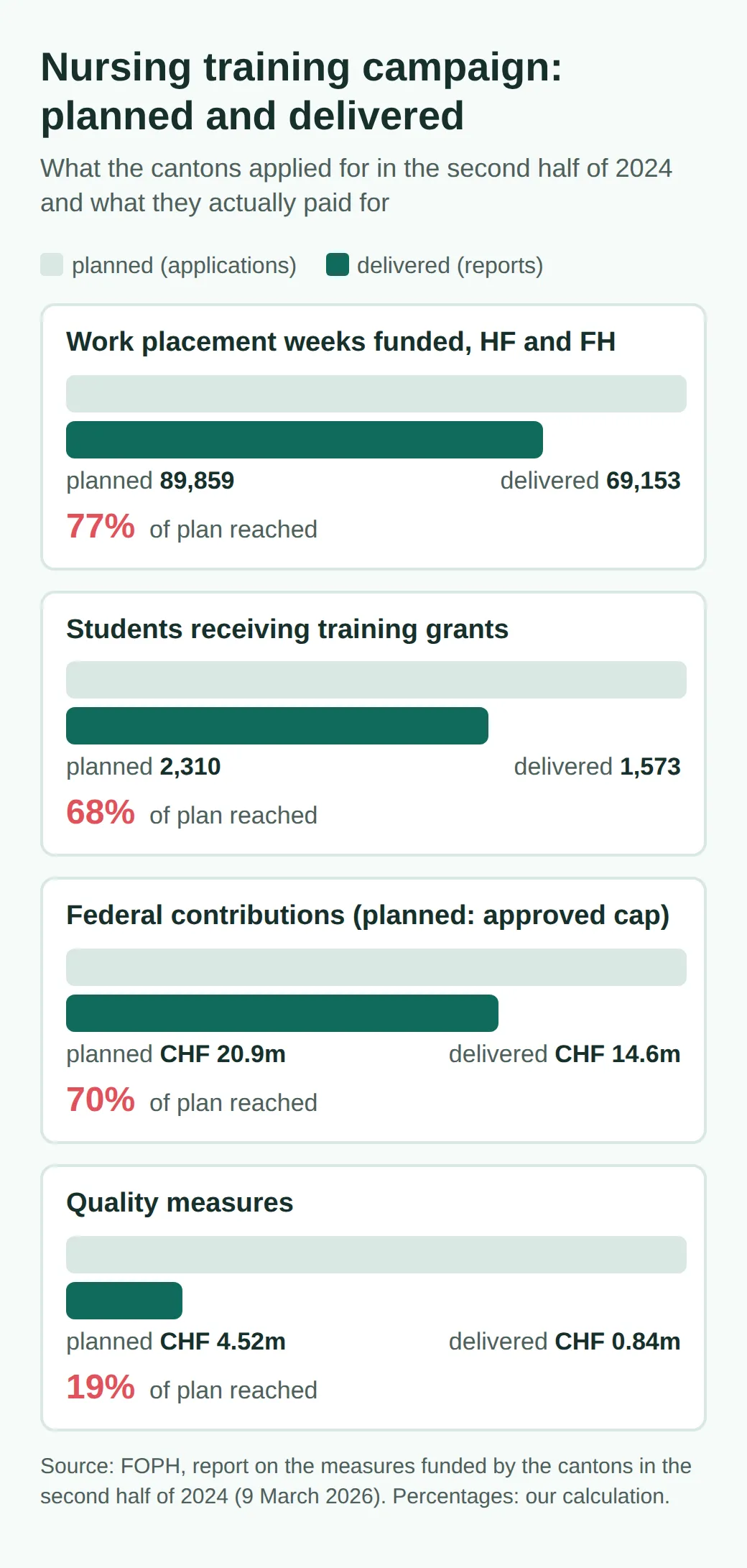
The gap is widest for training grants. The cantons had expected 2,310 students; they supported 1,573. For quality measures, such as further training for workplace trainers or training networks shared by several employers, only CHF 0.8 million was spent instead of 4.5 million. The FOPH gives the reason: many cantons had no past figures to go on, and some could only start their programmes later or more slowly. Overall, 70 percent of the approved federal contributions were drawn, ranging from 30 to 130 percent depending on the canton.
The work placement weeks are worth a second look. 86,408 weeks were completed, around four fifths of them by HF students. But contributions were paid for only 69,153, because cantons such as Aargau, Bern and St. Gallen only pay hospitals for the weeks that go beyond their existing training obligation. Money that isn't drawn doesn't expire. It remains available to the cantons in later years, provided Parliament approves the annual budget.
Nobody can say yet whether more people will complete nursing training. The FOPH itself writes that the period is too short for reliable conclusions about the effect. It also points to a risk: 13 cantons were already supporting employers before 2024. There, federal money could replace existing support instead of creating new training places. The Federal Council must report to Parliament on the effect no later than six years after the start, so by mid-2030.
Where the 2024/2025 money goes
For the 2024/2025 round, the Confederation made CHF 75 million available and approved CHF 72.3 million as upper limits, as the list of federal contributions (in German) shows. Zurich receives the most, CHF 14.0 million, followed by Bern with 8.1 million and Lucerne with 6.5 million. The canton of Zurich itself is putting around CHF 100 million into nursing training over the eight years. Things are moving at the colleges too: 29 students had signed up for the first part-time HF nursing programme in Central Switzerland, starting in November 2025, according to the cantons' report to the State Secretariat for Education, Research and Innovation (SERI) (in German). But training is only half the job. The other half, working conditions, is before Parliament.
The new nursing law in the National Council
On 21 May 2025, the Federal Council presented the Federal Act on Working Conditions in Nursing, known by its German abbreviation BGAP. It covers ten areas, from maximum working hours, breaks and time for changing clothes to how far ahead rosters must be known. The Federal Council wanted rosters to be set at least four weeks in advance. Employers and unions were also to be required to negotiate collective labour agreements (CLAs, in German GAV). A CLA may depart from the law, but the mandatory rules of the Labour Act and of cantonal staff legislation still apply, as the FOPH (in German) explains.
On 28 April 2026, the National Council was the first chamber to debate the law. After six hours of debate (in German), it cut it back in many places. It rejected two motions to send the bill back to the Federal Council, by 105 votes to 87 and 106 to 87. In the final vote it passed the BGAP by 95 votes to 61, with 39 abstentions. That's what Parliament's voting records show. The centre-right majority got its way almost everywhere. The Social Democrats and the Greens wanted more requirements and lost on all but a few points.
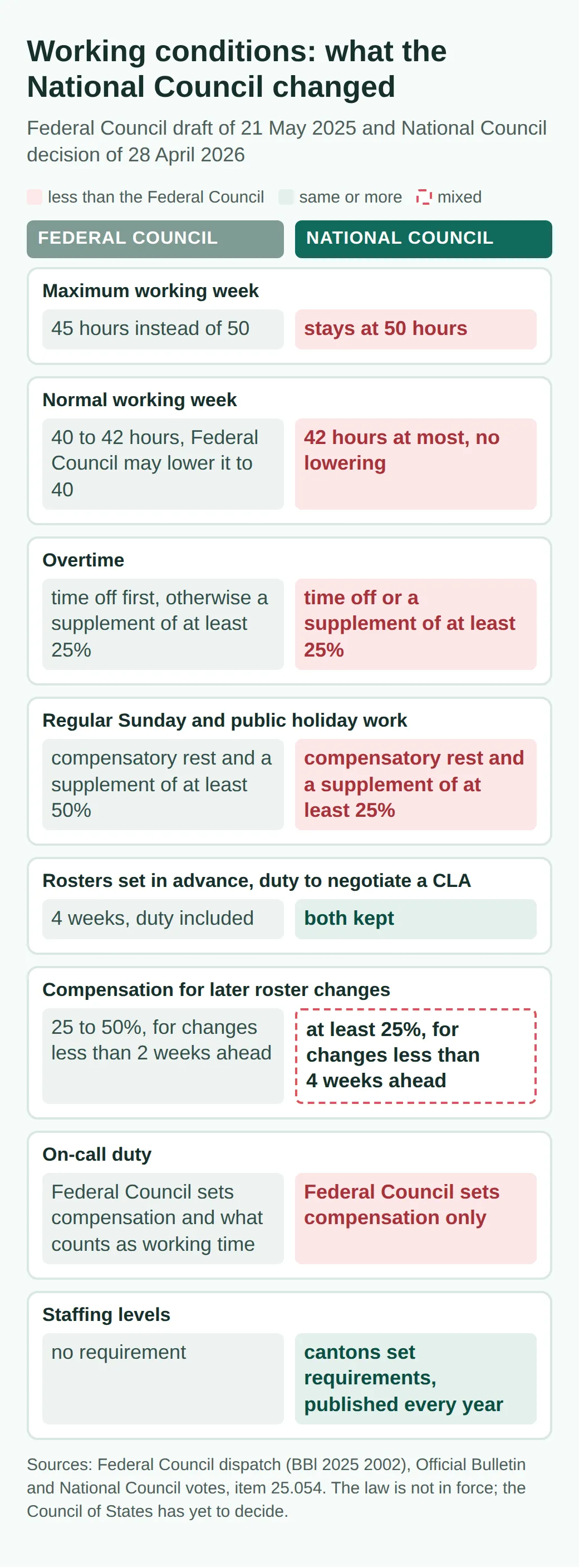
The main differences: the maximum working week stays at 50 hours instead of falling to 45. The normal working week is 42 hours at most, and the Federal Council doesn't get the power to lower it to 40. If you regularly work on Sundays or public holidays, you would get a supplement of at least 25 percent on top of compensatory rest, half what the Federal Council had planned. Overtime is compensated with time off or a supplement of at least 25 percent; the chamber struck out the rule that time off comes first. On rosters the picture is mixed. They must be set four weeks in advance, as the Federal Council planned. If a shift is changed after that, you get compensation of at least 25 percent. The Federal Council had planned 25 to 50 percent, but only for changes made less than two weeks before the shift. The chamber kept the duty for employers and unions to negotiate a CLA, by 103 votes to 86.
On one point the National Council went further than the Federal Council. On a proposal from the Green Liberals, the cantons must set staffing requirements for nursing care. Whether employers meet them is to be published every year, for each employer and each area of care. The Federal Council had deliberately left out a staffing rule. In its dispatch (in German) it explains why: there's no reliable evidence on how to calculate the right level of staffing.
Costs were the main point of conflict
The centre-right majority's main argument was cost. "Overall, we're talking about an additional two to four percent in premium increases," said Diana Gutjahr, a National Councillor for the Swiss People's Party (SVP), according to the Keystone-SDA news agency (our translation). The other side countered that without better conditions even more nurses would leave the profession. "Applause and thanks alone aren't enough," said Farah Rumy, a Social Democrat National Councillor and registered nurse. The day before the debate, nurses had handed in a petition with almost 190,000 signatures.
On funding, the National Council decided that in the long run the extra costs should be built into the tariffs for hospital and outpatient treatment. For home care and care homes, the Confederation and the cantons are to share them half and half until uniform financing of outpatient and inpatient services (EFAS) takes over. According to the FOPH, EFAS only comes into force for nursing care in 2032. Until all this applies, your working hours remain governed by current law.
What applies to your working hours today
Until the BGAP comes into force, the rules are those of the Labour Act, the Code of Obligations, cantonal staff legislation and, where there is one, your CLA. The Labour Act allows up to 50 hours a week in hospitals and care homes. For temporary Sunday work it requires a 50 percent pay supplement; for regular Sunday work it requires none. That's exactly the gap the BGAP would close, even in the National Council's version. Staff at public hospitals and care homes may fall under cantonal or municipal staff law instead of the Labour Act.
What that means for you: the supplements, breaks and roster deadlines in your contract today come from your CLA or your employer's staff regulations, not from the nursing initiative. But the bill has a second part besides working conditions.
Advanced practice nurses: the second part of the bill
By amending the Health Professions Act, the Federal Council wants to regulate the profession of the advanced practice nurse (APN) by law. These specialists are to take on tasks in primary care and relieve both nursing teams and doctors. Only someone with a master's degree in APN would be allowed to work as an advanced practice nurse. The National Council passed this part by 101 votes to 67, with 26 abstentions.
This matters to you mainly if you're planning a career beyond the HF or FH diploma. When these rules apply will be decided together with the BGAP in the Council of States.
When will the Council of States decide?
There's no date yet. On 2 September 2026, the Council of States' Committee for Social Security and Health (SSHC-S) unanimously agreed to take up both bills. In its press release (in German), it notes that the National Council changed the draft substantially, and it calls for solutions that are proportionate, affordable and workable for employers. It plans to start the article-by-article review in the fourth quarter of 2026.
Several steps remain after that. First the full Council of States decides. If it departs from the National Council, the bill goes back and forth until both chambers have agreed on the same text. Then comes the final vote. Once the act is published, 50,000 voters or eight cantons can call a referendum within 100 days (Art. 141 of the Federal Constitution). Only after that does the Federal Council decide when the law comes into force.
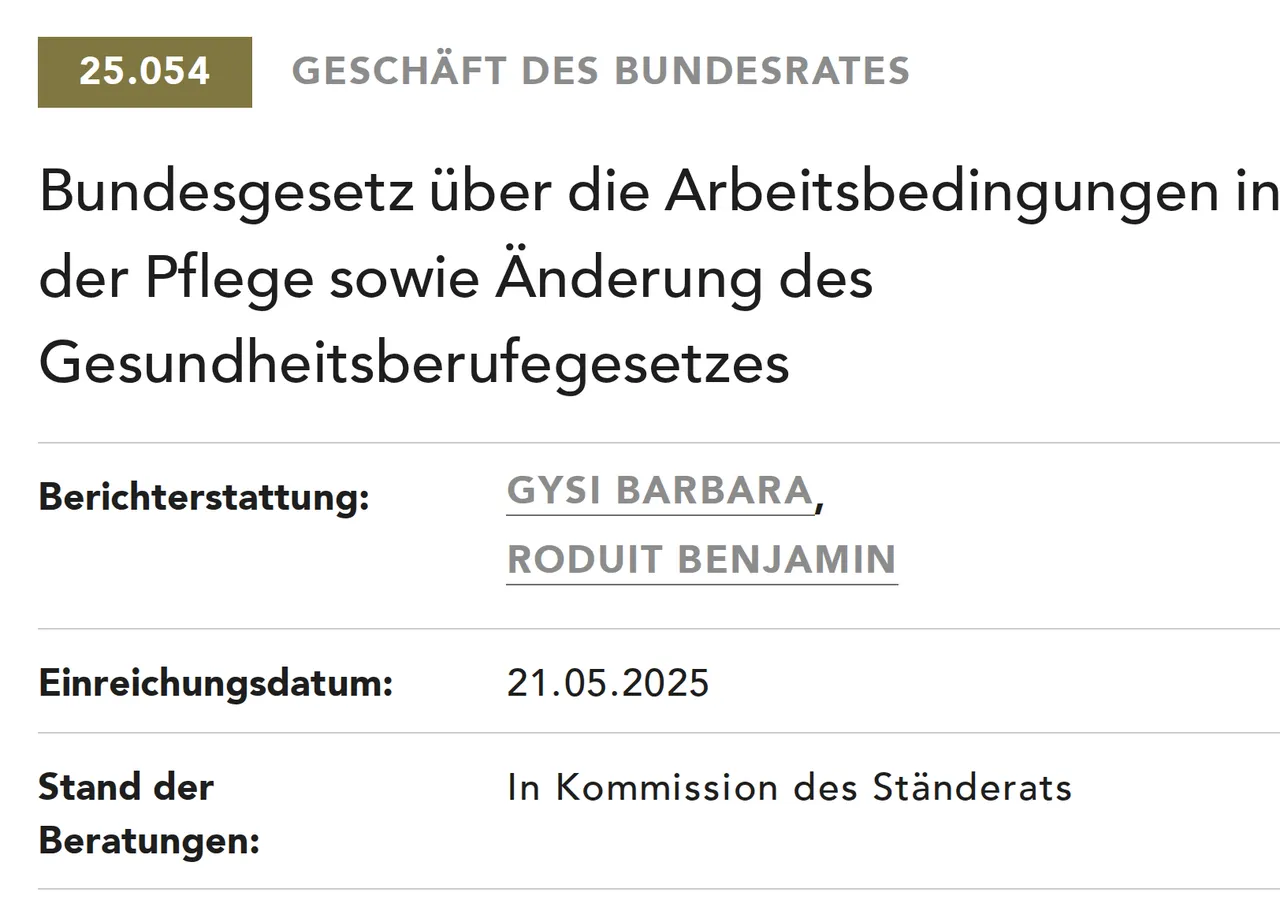
You can follow progress yourself. Search for the number 25.054 in Parliament's Curia Vista database. On the item's page you can subscribe to it and get notified at every step. That's also where you'll find the side-by-side text (the Fahne) comparing the versions of the Federal Council, the National Council and later the Council of States.
What's still open
Almost everything that affects your working day. It's not yet clear whether the Council of States goes back to the Federal Council's version on maximum hours, supplements and rosters, or follows the National Council. Nor is it clear whether the staffing requirements the National Council added will stay. And funding is unresolved: the FOPH writes that the extra costs are hard to estimate and their effect on premiums can't yet be put into figures.
A decision is coming on training too. The FOPH wants to gather the cantons' experience and use it for the second phase of the training campaign, from 2028 to 2032. Programmes that are slow to get going today may still change by then.
What you can do now
If you're starting nursing training at HF or FH level, or are already studying: ask your home canton about training grants, ideally before the semester starts. Some cantons require you to stay in the profession for a few years after you graduate, Solothurn for example for three years. The FOPH figures show that fewer students receive grants than the cantons had budgeted for. Applying costs you little.
If you already work in nursing, don't count on the federal law changing your working hours any time soon. Until further notice, what's binding is what your CLA or staff regulations say. Check the supplements for Sundays and short-notice shifts there before you accept a new job.
And if you want to work as a nurse in Switzerland with a diploma from abroad, the nursing initiative applies to you just the same once your qualification is recognised. We explain how recognition by the Swiss Red Cross works in our article on recognition of foreign nursing diplomas.
Common questions
- Do nursing training grants cover the healthcare assistant (FaGe) apprenticeship?
- No. The training grants and the contributions for work placement weeks only support training as a registered nurse at a college of higher education (HF) or a university of applied sciences (FH). This law provides no money for the healthcare assistant apprenticeship (Fachfrau or Fachmann Gesundheit EFZ).
- Can I get a nursing training grant if I study in another canton?
- The canton you live in is responsible, not the canton where your school is. Cross-border commuters receive grants from the canton their cross-border status is tied to. Each canton sets its own conditions and amounts.
- Do I have to pay back a nursing training grant in Switzerland?
- That depends on the canton. Solothurn, for example, requires you to work as a registered nurse for at least three years within six years of graduating, at an average workload of at least 40 percent. Solothurn sets out repayment in a separate information sheet. Read your home canton's information sheets before you apply.
- Can a referendum still stop the new Swiss nursing law?
- Yes. A referendum can be called against any federal act. It takes 50,000 signatures or eight cantons within 100 days of the act's publication. Only after that can the Federal Council bring it into force.
- Can self-employed nurses in Switzerland bill health insurance without a doctor's order?
- For certain services, yes, since 1 July 2024: assessment, advice, coordination and basic care. You still need to be authorised to bill compulsory health insurance. If nursing costs in your canton rise faster than the Swiss average, the canton may stop authorising new organisations and nurses.
More posts
All posts
Pflegehelfer SRK 2026: Red Cross course cost, pay vs AGS
Swiss Red Cross nursing assistant course (Pflegehelfer SRK): cost in six cantons, what you may do, pay in Zurich, Bern and Lucerne, vs AGS and FaGe.

Return to Nursing in Switzerland 2026: Courses and Funding
Returning to nursing in Switzerland: which cantons pay for the refresher course, how to check GesReg and NAREG, and what onboarding to expect.

Night shift and on-call pay for nurses in Switzerland (2026)
Night shift pay for nurses in Switzerland: 10% extra time off by law, 25% more for occasional nights, and the hourly allowances in Aargau, Solothurn and Zug.